

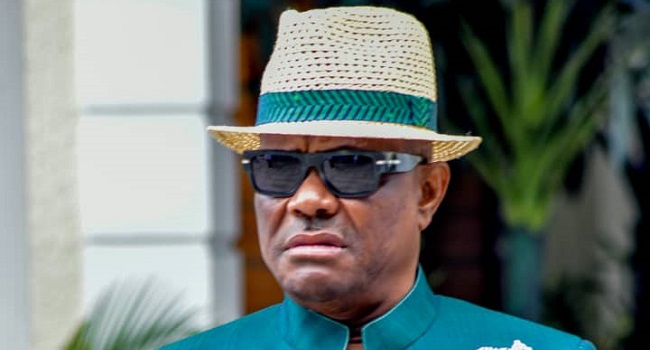
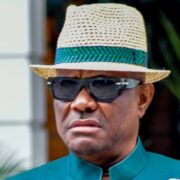
The political battle ahead of the 2027 general election intensified as Minister of the Federal Capital Territory (FCT), Nyesom Wike, sparked controversy with his declaration that Rivers State is politically secured for President Bola Ahmed Tinubu.
Wike had, during a media chat in Abuja, warned politicians hoping to win Rivers State in the 2027 presidential election to “forget it,” insisting that only Tinubu could emerge victorious in the state.
“I am telling you, let nobody make a mistake. The only person that can win Rivers State is Asiwaju Bola Ahmed Tinubu,” Wike said, describing himself as a “political realist.”
His comments became a major talking point on ARISE Television’s The Morning Show, where anchors Ayo Mairo-Ese, Rufai Oseni and Dr Reuben Abati offered sharply contrasting views on the implications of the minister’s statement.
Mairo-Ese dismissed Wike’s declaration as political posturing, describing it as “mind games,” “political big speak” and “psychological warfare” aimed at unsettling opponents ahead of the election.
She stressed that political influence does not translate into control over voters, arguing that the people of Rivers State would ultimately decide who wins the election.
“Wike has one vote, just like every other Nigerian. The people of Rivers State will determine who emerges as the winner,” she said.
Mairo-Ese, however, warned that statements suggesting that election outcomes had already been decided could discourage voters and worsen voter apathy.
She also challenged the Independent National Electoral Commission (INEC) to strengthen public confidence in the electoral process by ensuring that the 2027 elections are free, fair and credible.
But Oseni strongly disagreed with her interpretation, arguing that Wike’s statement should not simply be dismissed as political rhetoric.
According to Oseni, Wike’s confidence reflects concerns already held by many Nigerians about the credibility of the electoral process.
“With due respect, he is not saying what he has not done. He is saying what he has done,” Oseni said, referring to controversies surrounding the 2023 presidential election in Rivers State.
He cited reports and concerns over discrepancies between figures declared during the election and results uploaded on INEC’s Result Viewing (IREV) portal, arguing that such controversies have contributed to public distrust in elections.
Oseni maintained that many Nigerians already believe the electoral process is compromised and warned against dismissing those concerns simply to encourage voter participation.
“We keep saying we don’t want voter apathy, but many people already believe the process is a charade already,” he said.
However, Abati rejected the suggestion that Wike or any other politician could determine the outcome of the 2027 election.
“Wike is just like every other Nigerian qualified to vote. He has only one vote,” Abati said.
“He cannot sit today and announce the outcome of the 2027 election in Rivers State.”
Abati described Wike’s position as “a trip of delusion,” stressing that the power to declare election results rests with INEC and not individual politicians.
He urged Rivers State voters to exercise their democratic rights and make their own informed choices at the polls.
The discussion also turned to recent criticism of the Tinubu administration by Catholic leaders, including Archbishop Emeritus Cardinal John Onaiyekan and Monsignor Obiora Ike.
The analysts considered claims that individuals around the President may be shielding him from the realities confronting Nigerians.
Oseni disagreed with that assessment, insisting that Tinubu is aware of the hardship and other challenges facing citizens.
“There is no way the President will not know about all these things. He knows,” Oseni said.
He argued that the major challenge confronting the administration was not a lack of awareness but the difficulty in convincing Nigerians that its economic policies were producing meaningful improvements in their lives.
“The issue is not awareness. The issue is whether the government’s narrative is landing with Nigerians,” he said.
Abati, meanwhile, defended the right of religious leaders to criticise government policies, describing such interventions as part of the Catholic Church’s long-standing role in speaking on issues affecting society.
“The Catholic Church has a reputation for speaking its mind. They are not in the business of opposing the government for the sake of it,” he said.
He urged the government to view criticism from religious leaders as constructive rather than hostile.
“What we want in Nigeria is a prophetic Church that defends the interest of the people and speaks truth to power,” Abati added.
The heated exchange underscored growing concerns over electoral credibility, political influence, governance and public trust as Nigeria moves closer to the 2027 general election.





Comments