

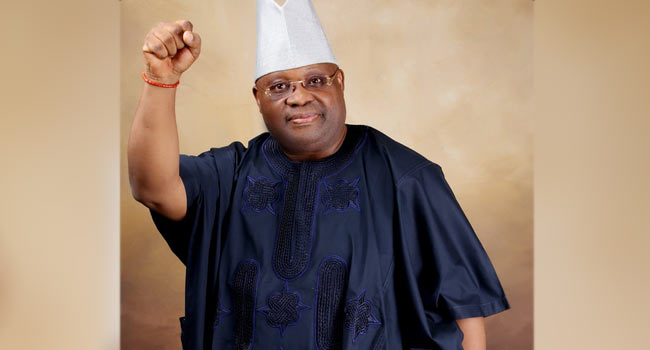
For Osun State Governor Ademola Adeleke, the celebrations following his victory in the August 15 governorship election are gradually giving way to the more demanding task of governance.
Adeleke secured another four years in office after defeating the All Progressives Congress (APC) candidate, Bola Oyebamiji, in a fiercely contested election that witnessed intense political mobilisation across the state.
But beyond the victory figures and celebrations, the election has opened a new chapter for the Adeleke administration.
While his first term focused largely on establishing his government, introducing new policies, executing projects, rebuilding political structures and convincing voters to grant him another mandate, the second term will come with significantly greater expectations.
There will be less room for explanations and greater pressure for results.
Adeleke now has an opportunity to consolidate his achievements, address shortcomings and pursue projects that could ultimately define his legacy in Osun.
From Victory to Governance
Adeleke’s re-election was not only a vote of confidence in his administration; it was also a challenge to deliver more.
The governor will now be judged by measurable improvements in the lives of residents, including job creation, infrastructure development, improved education and healthcare, investment attraction and support for businesses.
Young people are expected to remain a major focus, particularly as unemployment and limited economic opportunities continue to drive demands for a more productive state economy.
Adeleke has repeatedly expressed his desire to move Osun away from its traditional dependence on the civil service and towards an economy driven by industries, private investment and productive activities.
“I am tired of hearing Osun State as a civil service state,” the governor has said.
That ambition could become one of the defining themes of his second term.
The Industrialisation Gamble
Industrialisation is expected to occupy a prominent place in Adeleke’s second-term agenda.
The governor has spoken about developing a free trade zone and attracting industries to the state, a strategy that could have implications beyond government revenue.
Successful industrial clusters could create direct employment while also stimulating demand for housing, transportation, food, logistics and other services.
However, attracting investors will require more than political declarations.
Investors will consider the availability of electricity, quality roads, security, land, taxation, ease of doing business and access to markets.
This means Adeleke’s industrialisation plans will inevitably be tied to his infrastructure agenda.
“We want to industrialise Osun State,” he has said.
The next four years will determine whether that ambition translates into functioning industrial clusters, new businesses and significant private-sector investment.
The Airport Question
Another project likely to attract attention during Adeleke’s second term is the Osun airport.
The governor has listed completion of the project among his priorities, with supporters pointing to its potential to improve connectivity and stimulate economic activity.
A functional airport could support tourism, agriculture, commerce and investment while providing an additional transportation link for residents and businesses.
However, the project will also have to demonstrate economic viability.
Adeleke will need to convince both investors and residents that the airport can become a sustainable economic asset rather than simply a political landmark.
“We are going to complete the airport,” he has said.
If completed and effectively utilised, the project could become one of the most prominent infrastructure achievements associated with his administration.
Infrastructure and Grassroots Development
Beyond the airport, roads and other infrastructure are expected to remain central to Adeleke’s second-term agenda.
Good roads are particularly important to Osun, where agriculture and small businesses play significant roles in the economy.
Farmers need reliable access to markets, students need roads to schools, patients need access to hospitals, while businesses depend on efficient transportation networks.
The governor will therefore face pressure to balance major projects with smaller interventions that directly affect communities.
Residents are likely to measure his second term not only by high-profile projects but also by the condition of roads, schools, health facilities and other public infrastructure in their neighbourhoods.
Workers’ Welfare
Workers’ welfare is another area that could shape Adeleke’s second term.
His administration has placed significant emphasis on salaries, workers’ welfare and support for pensioners, policies that have earned political goodwill among sections of the state workforce.
Adeleke has described workers as important partners in the development process.
“Our workers are our partners in development,” he has said.
Maintaining that relationship will be important, particularly as the government faces competing demands for spending on infrastructure, education, healthcare and economic development.
The challenge will be sustaining improved welfare while ensuring that other critical sectors are adequately funded.
Education and Healthcare
Education and healthcare will also provide important measures of the governor’s performance.
In education, residents will expect the administration to consolidate previous interventions while improving school facilities, learning environments and access to skills that prepare young people for a changing economy.
Healthcare presents a similar challenge.
Beyond renovating facilities, the government will need to improve access to quality healthcare, strengthen primary healthcare centres and ensure that hospitals are properly equipped and staffed.
For residents, success in these sectors will ultimately be measured less by ceremonies and announcements than by their everyday experiences in schools and hospitals.
Agriculture and the Rural Economy
Agriculture remains another major opportunity for Osun.
With significant agricultural land and a large rural population engaged in farming, the sector could play an important role in Adeleke’s economic plans.
The administration could focus on access to farm inputs, mechanisation, storage, processing and markets while encouraging farmers to participate in broader value chains.
Moving beyond the production of raw agricultural commodities could create opportunities for processing industries, generate jobs and increase the income of farmers.
That approach could also connect Adeleke’s agricultural ambitions with his industrialisation plans.
The Reconciliation Challenge
Perhaps one of the governor’s immediate political responsibilities will be reconciliation.
The election was fiercely contested, with the APC and other opposition forces investing heavily in the campaign.
Adeleke’s declaration that there should be “no victor, no vanquished” therefore carries considerable significance.
The real test will be whether that message translates into concrete action.
The governor has an opportunity to reach out to political opponents, traditional institutions, civil society groups, professional organisations and other stakeholders.
A broader political consensus could help create the stability required to pursue long-term development projects.
For a state with a history of intense political competition, reconciliation could itself become an important part of Adeleke’s legacy.
The Tinubu Factor
The relationship between Adeleke and President Bola Ahmed Tinubu could also influence the governor’s second-term prospects.
Tinubu congratulated Adeleke on his victory and urged him to unite the people of Osun and focus on development.
For Adeleke, maintaining a productive relationship with the Federal Government could be important for attracting support in areas such as infrastructure, investment, agriculture and security.
The governor will therefore have to balance his political identity with the practical need for cooperation between Osun and Abuja.
If the relationship remains cordial, the state could benefit from stronger collaboration between the federal and state governments.
The Political Capital of Victory
Adeleke enters his second term with significant political capital.
His victory has strengthened his position in Osun politics and given him greater freedom to pursue his agenda.
But political capital can quickly disappear if expectations are not met.
The same voters who returned him to office will eventually assess his performance.
The governor must therefore convert his electoral mandate into institutions, policies and projects capable of surviving beyond his tenure.
That will ultimately determine the difference between political success and a lasting legacy.
A New Test for Adeleke
Adeleke’s second term will also test his ability to move from personality-driven politics to institution-driven governance.
His popularity and political appeal helped secure re-election, but sustainable development requires strong institutions, competent personnel, transparent processes and effective implementation.
The governor will need to strengthen the machinery of government so that policies and programmes do not depend solely on his personal energy.
His second term provides an opportunity to establish systems capable of continuing to serve Osun long after he leaves office.
Managing Expectations
Perhaps the greatest challenge ahead is managing expectations.
Election campaigns naturally generate optimism. Supporters expect quick delivery, communities want projects, workers want improved welfare, young people want jobs, businesses want incentives and farmers want greater support.
Government resources, however, remain limited.
Adeleke will therefore have to prioritise projects with the greatest potential to transform the state’s economy and improve the lives of residents.
Regular communication with citizens will also be important, particularly on what the government can deliver, when it can be delivered and the resources required.
The Legacy Question
For Adeleke, his second term is likely to be remembered less for the political battles that returned him to office and more for what he does with the mandate.
He now has four years to determine what his administration will mean in the history of Osun State.
Will he be remembered primarily as the governor who secured re-election, or as the governor who transformed the state’s economy, improved infrastructure, strengthened human capital and attracted significant investment?
That is the bigger question.
Adeleke has described his second term as one focused on consolidation and development.
That pledge now carries greater weight.
The election is over. The campaign banners will eventually disappear, while political rallies will give way to cabinet meetings, project monitoring, budgets and policy implementation.
Adeleke has won the mandate.
Now comes the harder part: turning that mandate into a lasting legacy.







Comments