

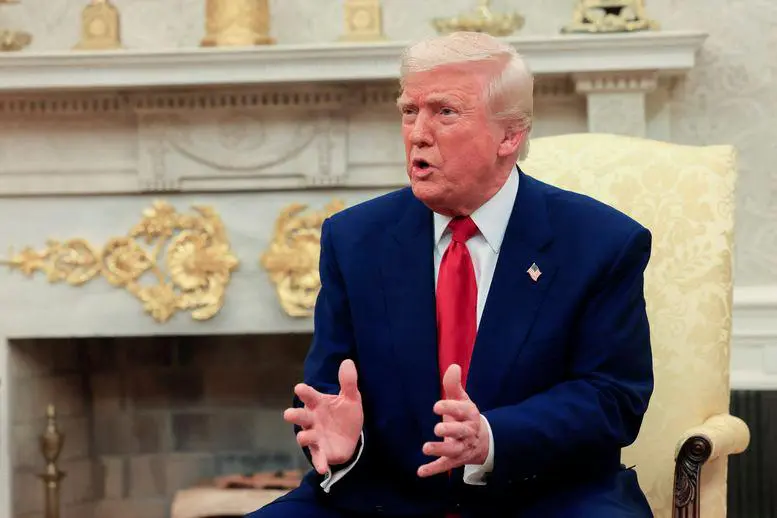
WASHINGTON, D.C. — United States President Donald Trump will only approve a peace agreement with Iran if it fully meets Washington’s conditions, a White House official said on Friday, amid growing uncertainty over negotiations aimed at ending the conflict that has destabilized the Middle East and rattled global markets.
The development comes despite earlier indications from the White House that Trump was nearing a decision on a proposed agreement. Iranian officials, however, insisted that no final deal has been reached and challenged key aspects of the U.S. president’s description of the ongoing talks.
Following a two-hour meeting in the White House Situation Room, Trump stopped short of approving any agreement.
“President Trump will only make a deal that is good for America and satisfies his red lines,” a White House official told AFP, emphasizing that Iran must never possess a nuclear weapon.
In a lengthy social media post, Trump reiterated Washington’s longstanding demands, including a permanent commitment by Tehran not to pursue nuclear weapons and the reopening of the strategically vital Strait of Hormuz to international shipping.
Iran swiftly rejected what it described as Washington’s attempts to dictate terms. Foreign Ministry spokesman Esmaeil Baqaei told state media that the Islamic Republic had long moved beyond accepting foreign ultimatums.
“Iran said goodbye to the language of ‘must’ 47 years ago,” Baqaei said, while confirming that exchanges of messages between both sides were continuing. He stressed, however, that “no final agreement has been reached yet.”
Iranian President Masoud Pezeshkian also signaled openness to diplomacy, telling the Emir of Qatar during a telephone conversation that Tehran was prepared to pursue a “dignified framework” for ending the conflict, according to the state-run IRNA news agency.
A major point of contention remains the details of the proposed agreement. Trump claimed that Iran would remove naval mines from the Strait of Hormuz, reopen the waterway without imposing tolls, and cooperate with the United States on the removal and destruction of enriched uranium stockpiles. He also stated that no financial transfers would occur under the arrangement “until further notice.”
However, Iran’s Fars News Agency cited sources disputing several of those claims. According to the report, Tehran is demanding the immediate release of $12 billion in frozen Iranian assets before advancing to the next stage of negotiations. The sources further denied that the agreement includes provisions regarding toll-free access through the Strait of Hormuz and dismissed claims about destroying Iran’s nuclear materials as “fundamentally baseless.”
Baqaei also maintained that there are currently no direct negotiations underway regarding Iran’s nuclear programme, suggesting that Washington’s approach has become a major obstacle to progress.
As conflicting narratives emerge from both capitals, uncertainty continues to dominate public perception.
“Both sides are speaking in a way that keeps their supporters satisfied. It’s not clear who is telling the truth,” said Ali, a resident of Tonekabon in northern Iran.
The uncertainty has fueled volatility in global energy markets, with investors closely monitoring developments surrounding the Strait of Hormuz, one of the world’s most critical oil shipping routes.
Meanwhile, tensions remain high across the wider region. Washington and Tehran have accused each other of violating a fragile truce around the strategic waterway, while military exchanges continue between Israel and Hezbollah in Lebanon.
Israeli Prime Minister Benjamin Netanyahu announced that Israeli forces had expanded operations deeper into Lebanese territory. Hezbollah, in turn, claimed responsibility for a series of drone attacks targeting Israeli military positions in northern Israel.
The clashes occurred as Israeli and Lebanese military delegations held security discussions in Washington, talks that were described by Pentagon official Elbridge Colby as “productive.”
Despite a ceasefire agreement that was expected to take effect in April, hostilities between Israel and Hezbollah have continued, with both sides accusing each other of repeated violations.
As diplomatic efforts continue, hopes for a breakthrough remain alive, but stark disagreements between Washington and Tehran suggest that any final agreement could still face significant hurdles.


















Comments