

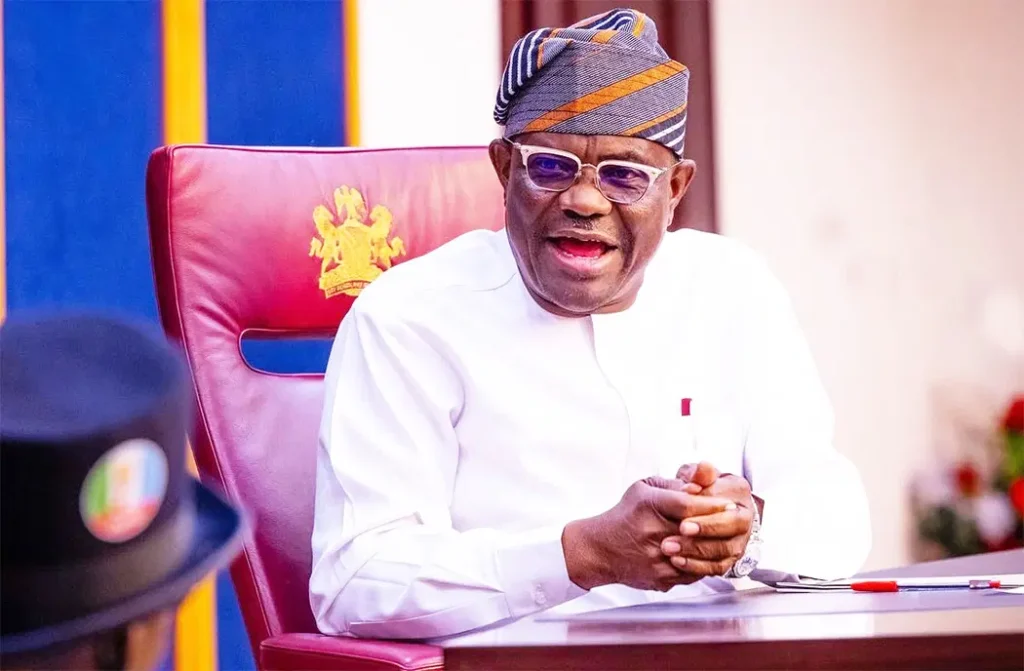
Minister of the Federal Capital Territory (FCT), Nyesom Wike, on Tuesday expressed confidence that the ruling All Progressives Congress would record stronger electoral success in the FCT ahead of the 2027 general elections, citing growing grassroots acceptance and widespread appreciation for ongoing infrastructural development across the territory.
Wike made the remarks after inspecting six major projects slated for commissioning as part of activities marking the second anniversary of President Bola Ahmed Tinubu’s administration.
According to the minister, residents of the FCT are beginning to witness “governance in action,” especially through the extension of infrastructure to satellite towns and rural communities that had suffered years of neglect.
“What the people want is simple — they want to feel the impact of governance. Nigerians are interested in good governance, infrastructure, electricity and improved living conditions,” Wike stated.
He disclosed that no fewer than 20 projects would be inaugurated during the anniversary celebrations, noting that the number could increase as additional projects near completion.
Among the projects listed were the Bwari and Karu water schemes, roads linking Gomani to Yangoji, and the Kuje-Gwagwalada road project, alongside developments in the Abuja Municipal Area Council (AMAC) and Bwari Area Councils.
Wike also took a swipe at opposition figures and coalition groups, challenging them to inspect the projects across the capital territory.
“I think it will be interesting for the public to see governance in action. I wonder where the opposition or coalition members are. They should come and see what is happening in the FCT,” he said.
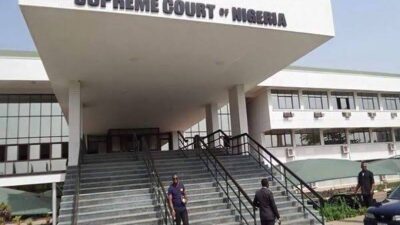
The inspection tour covered several strategic infrastructure projects, including the rehabilitation of the Appeal Court Complex in Dakibiyu, Judges’ Quarters in Katampe, internal roads in Katampe District, and the new relocation site for the Apo Mechanic Village.
At the Dakibiyu Appeal Court Complex, Wike said work had reached about 70 percent completion, with contractors handling final finishing works such as painting and polishing.
He also inspected newly constructed residences for judges of the Court of Appeal, Federal High Court and FCT High Court, describing the level of work as nearly complete. The minister further visited sites designated for the Industrial Court and Code of Conduct Tribunal quarters, commending the pace and quality of construction.
Other inspected projects included the Collector Road corridor, where walkways and streetlights are nearing completion, as well as road and lighting works in Gaduwa and Kabusa.
At the Apo informal sector relocation site, designated for traders and mechanics displaced from the Apo Mechanic Village, Wike confirmed that roads and streetlights had already been completed, while water connection remained the major outstanding component.
He added that security agencies had been directed to commence construction of a police station and residential quarters for officers within the settlement.
“At the informal sector site where Apo Mechanic Village traders will be relocated to, the roads and streetlights are already completed. What is remaining now is water connection,” he said.
Addressing concerns over the APC’s performance in the FCT during the 2023 presidential election — where President Tinubu secured less than 25 percent of votes cast — Wike argued that recent Area Council election results already showed signs of shifting political sentiment.
“What reason would people have not to vote for Mr President now? This is the first time people are seeing development extend beyond the city centre into the satellite towns,” the minister said.
He pointed to the commissioning of the A2-Pai Road in Kwali as evidence of the administration’s commitment to rural development, describing it as the first time a sitting Nigerian president had visited the community for a project inauguration.
Responding to claims that the administration was prioritising judicial infrastructure over other sectors, Wike dismissed the criticism, insisting that investments were being spread across critical sectors including water supply, schools and public welfare.
“For the judiciary to be independent, you must provide the necessary infrastructure, welfare and working conditions. It is not only about the judiciary. We are also providing water, schools and other basic needs for Nigerians,” he added.
The minister maintained that the spread of projects across the FCT reflected an inclusive development agenda aimed at improving living conditions for both urban and rural residents.












Comments