

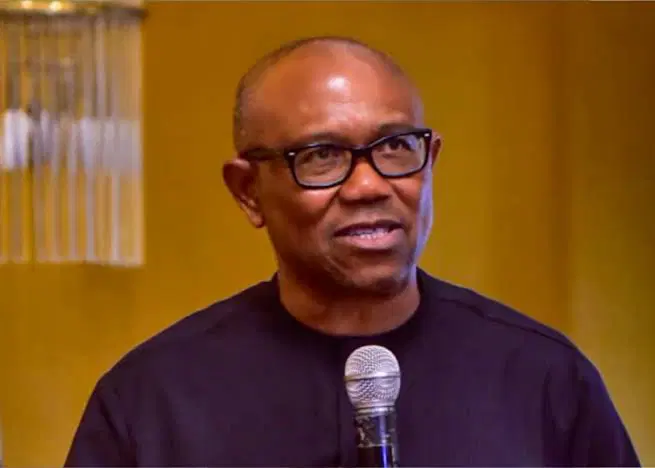
The presidential candidate of the Nigeria Democratic Congress (NDC), Peter Obi, has called on the Nigerian government to adopt South Africa’s transparent approach to public borrowing, stressing that accountability and measurable impact should guide every loan obtained in the name of citizens.
Obi made the remarks on Thursday in a statement shared via his verified X account, where he cited South Africa’s recently secured $1 billion loan from the New Development Bank as an example of responsible and accountable borrowing.
According to the former Anambra State governor, borrowing is not inherently wrong, as nations around the world rely on loans to finance development projects. However, he emphasized that the true test of responsible governance lies in how borrowed funds are utilized and whether citizens can clearly see the benefits.
“There is a lot to learn from the open and transparent manner in which South Africa handled its recently secured $1 billion loan, with a clearly defined purpose,” Obi stated.
He noted that the South African government openly outlined the projects to be funded, the expected outcomes, and the benefits to citizens, describing the approach as a model Nigeria should emulate.
“This is what accountable borrowing should look like. The purpose is clear, the projects are identifiable, and the expected benefits to citizens are measurable. Such investments directly improve living conditions, enhance productivity, and stimulate economic growth,” he said.
Obi, however, expressed concern over Nigeria’s growing debt profile, alleging that the current administration has significantly increased public debt without providing adequate details on how the funds are being deployed.
According to him, Nigeria’s total public debt has risen from about ₦87 trillion in 2023 to nearly ₦200 trillion, while many citizens remain unaware of the specific projects financed through the borrowings.
“Despite this unprecedented accumulation of debt, Nigerians are often left without a clear and detailed account of how these borrowings are being deployed to improve critical sectors such as education, healthcare, power, security, and infrastructure,” he said.
The former governor maintained that borrowing should never become an end in itself but must be linked to productive investments capable of generating economic growth, creating jobs, reducing poverty, and improving citizens’ welfare.
He further stressed that transparency and accountability are fundamental principles of good governance, arguing that governments must be able to explain what was borrowed, where the funds were invested, and the measurable outcomes achieved.
“At a time when millions of Nigerians are struggling with rising living costs, unemployment, insecurity, and declining purchasing power, fiscal discipline and prudent management of public resources are no longer optional—they are imperative,” Obi said.
He concluded by urging policymakers to ensure that every borrowing decision is guided by one key consideration: its direct impact on the lives of ordinary Nigerians.
“Every borrowing decision should answer one simple question: How does this improve the life of the ordinary Nigerian? If that question cannot be convincingly answered, then we risk merely transferring today’s burdens to future generations,” he added.














Comments