

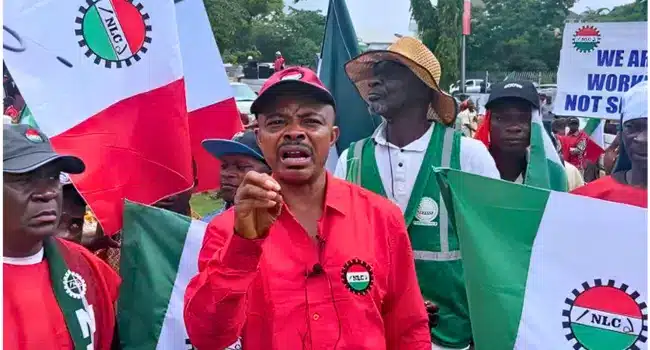
The Nigeria Labour Congress (NLC) has called on the Federal Government to deploy part of the additional revenue generated from rising international oil prices to cushion workers and other Nigerians from the impact of higher fuel, transportation and food costs.
NLC President, Joe Ajaero, made the call at the 2026 National Pre-Retirement Summit organised by XEM Consultants Limited in Abuja, where he argued that increased oil revenues should translate into measures that protect citizens from the economic pressures associated with rising fuel prices.
Ajaero said the recent rise in global oil prices had created additional earnings for oil-producing countries, including Nigeria, and questioned why part of the windfall could not be channelled into intervention programmes for workers and vulnerable Nigerians.
He also argued that minimum wage negotiations should not focus solely on nominal figures but should take into account inflation, food prices, transportation costs, fuel prices and the overall purchasing power of workers.
According to him, a higher salary could quickly lose its value if the prices of essential commodities continued to rise.
The NLC president further called for the indexation of wages and pensions to inflation or the cost-of-living index, saying such a system would allow workers’ incomes to adjust automatically as economic conditions change.
Ajaero also advocated for the minimum pension to be considered alongside the minimum wage, stressing that pensioners were equally affected by rising living costs.
He said the decision to reduce the minimum-wage review cycle from five years to three years was intended to ensure that workers’ earnings could respond more quickly to changing economic realities.
Ajaero disclosed that the current minimum-wage agreement was expected to expire around March or April and called for negotiations to begin early. He, however, said labour’s immediate concern was how workers could cope with the current economic pressures before the next review.
He also questioned the effectiveness of measures such as the Compressed Natural Gas (CNG) programme in reducing transportation costs, asking how many vehicles had been converted and how accessible CNG refuelling facilities were across the country.
Meanwhile, the Minister of Aviation and Aerospace Development, Festus Keyamo, said the current ₦70,000 national minimum wage was inadequate to withstand the economic pressures confronting Nigerian workers.
Keyamo, who previously served as Minister of State for Labour and Employment, recalled the negotiations that preceded the increase in the minimum wage from ₦30,000 to ₦70,000 in 2024.
He said the current wage had been eroded by rising living costs and urged the Federal Government to meet organised labour midway in ongoing discussions, noting that unions had been calling for a substantial increase.
The minister also criticised the treatment of workers by some government agencies, particularly situations where workers allegedly struggle to access basic allowances while senior officials spend large sums on international trips.
He stressed that workers’ welfare remained essential to productivity and national development.
The summit’s convener and Chief Executive Officer of XEM Consultants Limited, Dr Eugenia Ndukwe, said the programme was designed to equip senior professionals with financial, health, entrepreneurial and investment skills for life after active service.
Ndukwe said the summit focused on financial management, health and wellness, entrepreneurship and investment, estate and wealth management, as well as agricultural enterprise systems.
She added that XEM Consultants partnered with Galaxy Backbone to provide participants with digital skills and tools for exploring opportunities created by technology, while promoting a more structured approach to retirement planning in Africa.

















Comments