

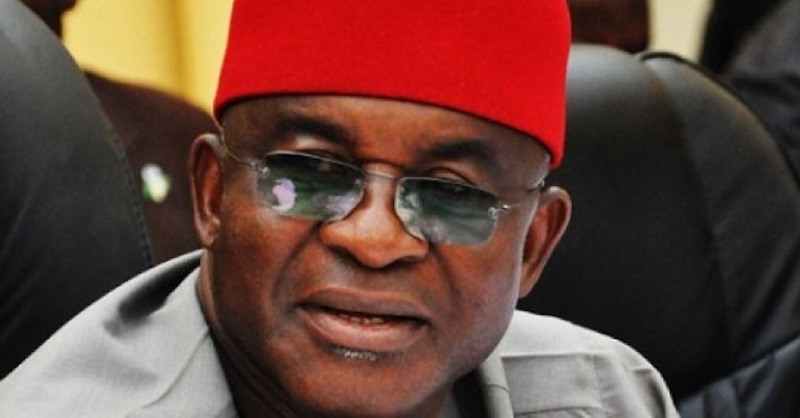
The Court of Appeal, Abuja Division on Monday, affirmed the judgment of a Federal High Court sitting in Abuja which restrained the Independent National Electoral Commission (INEC) from recognising or participating in any state congresses organised by committees appointed by the Senator David Mark-led caretaker leadership of the African Democratic Congress (ADC).
A three-member panel of justices of the appellate court, in a split decision of two-to-one, upheld the restraining order issued against the Sen. David Mark led caretaker committee of the ADC by the trial court judge, Justice Joyce Abdulmalik in her judgement delivered on April 29, 2006.
It further upheld the order of the trial judge, which restrained the Mark-led executives from interfering with the tenure and functions of the party’s elected state executives.
The appellate court, in the majority judgement, delivered by Justice Okon Abang held that, the responsibility for conducting state congresses of political parties rests with elected state executive committees, not with the national leadership.
Justice Abang held that, the appellant breached Section 223(1)(a) of the Constitution of the Federal Republic of Nigeria by non compliance with the Constitution in the conduct of its affairs, giving the trial court the jurisdiction to entertain the suit.
The majority judgement further dismissed the complaints of the appellant that, the subject matter of the suit was an internal affairs of the party.
He said that, the suspended state chairmen and the appointment of the caretaker committee by the ADC for the conduct of national convention was unlawful, unconstitutional, null and void.
The court held that, the party violated its own constitution by appointing caretaker committee when the tenure of the state chairmen of the party subsists, adding that, the court will cease to entertain cases, when political parties continue to violate it’s own constitution and that of the Federal Government of Nigeria.
While Justices Abang and Donatus Okorowo gave the majority judgement barring INEC from acknowledging the outcome of congresses held by the Mark-led leadership of the ADC, the presiding Justice of the three-member panel, Justice Abba Mohammed, gave a dissenting judgment.
In his minority decision, Justice Mohammed held that the case that led to the restraining order bordered on a non-justiciable internal affair of a political party, adding that, the trial court was wrong to have assumed jurisdiction to entertain the matter.
Justice Mohammed said, he found it difficult to agree with Justices Abang and Okorowo that, the trial court has the jurisdiction to entertain the matter.
He described both the majority decision and the judgement of the trial court as perversed and maintained that the dispute before the trial court was an internal affairs of the party, which is not justiciable.
Justice Mohammed held that, the actions of the 1st to 7th respondents in the appeal bis premature as they failed to exhaust the internal dispute resolution of the party before filing the suit and added that, the trial court was wrong to have assumed jurisdiction.
He said, “Any judgement entered by a court without jurisdiction is a nullity. Accordingly, the Federal High Court judgment delivered on April 29 is hereby set aside for want of jurisdiction. The appeal is meritorious and allowed”.
It would be recalled that the trial Court had, in its judgment, held that the four-year tenure of the ADC’s State Working Committees and State Executive Committees remained valid and subsisting, pending the conduct of properly constituted congresses and the convocation of a national convention.
The judgment followed a suit marked FHC/ABJ/CS/581/2026, lodged before the court by aggrieved members of the ADC.
Those behind the suit are Don Norman Obinna, Johnny Tovie Derek, Obah C. Ehigiator, Hon. Olona Yinka, Dr. Charles Idowu Omideji, Samuel Pam Gyang, and Obianyo Patrick, who told the court that they sued for themselves and on behalf of all State Chairmen and State Executive Committees of the African Democratic Congress (ADC).
Listed as defendants in the suit are the ADC; Sen. David Mark; Sen. Patricia Akwashiki; Mallam Bolaji Abdullahi; Ogbeni Rauf Aregbesola; and Prof. Oserheimen Osunbor (sued on behalf of the Caretaker/Interim National Working Committee); and INEC.
The plaintiffs had, among other things, challenged the decision of the Senator Mark-led leadership of the ADC to constitute committees for the purpose of conducting state congresses.
They challenged the validity of appointments made by the Mark-led caretaker committee, arguing that planned state congresses slated for April 2026, if conducted under the supervision of the said caretaker committee, would constitute a gross violation of the party’s constitution.
The plaintiffs stated that only duly elected party organs recognised under the party’s constitution possess the power to conduct congresses.
While agreeing with the plaintiffs, Justice Abdulmalik held that neither the 1999 Constitution, as amended, nor the Constitution of the ADC empowered the caretaker/interim National Working Committee led by Senator Mark to appoint committees for the purpose of conducting state congresses.
The court held that the claims brought before it by the plaintiffs were valid and deserving of judicial consideration, citing alleged breach of constitutional and statutory provisions.
It held that Section 223 of the 1999 Constitution, as amended, mandates political parties to conduct periodic elections based on democratic principles, adding that Article 23 of the ADC Constitution also provides that national and state officers shall hold office for a maximum of two terms spanning eight years.
Justice Abdulmalik stressed that although courts are generally reluctant to interfere in the domestic affairs of political parties, they nonetheless intervene where there is a clear allegation of violation of constitutional or statutory provisions.
She held that evidence before the court established that the tenure of the state executive committees of the ADC remained valid and must be allowed to run its full course without interference.
The court stressed that only those elected structures have the authority to organise state congresses, and it accordingly nullified any process initiated by the Senator Mark-led caretaker leadership.
Earlier, the court dismissed a preliminary objection filed by the defendants challenging the competence of the suit and the court’s jurisdiction to entertain it.
It held that the subject matter of the plaintiffs’ action pertained to the affairs of INEC and therefore fell within the jurisdiction of the Federal High Court under Section 251 of the 1999 Constitution, as amended.
The court also waved aside the defendants’ contention that the plaintiffs failed to exhaust internal dispute resolution mechanisms before instituting the action.
It held that the plaintiffs had the requisite locus standi (legal right) to file the suit.
The appellate court, while upholding the restraining order, said it had a duty to intervene so as to “prevent anarchy and ensure the survival of democracy in Nigeria.”
It cited a recent Supreme Court judgment in the leadership crisis rocking the Peoples Democratic Party (PDP) to hold that the ADC case could not be classified as a domestic affair of a political party.
“Once a complaint before the court is anchored on a constitutional infraction, the shield of internal affairs drops and the veil is lifted for judicial intervention,” Justice Abang added in the majority judgment.
Consequently, the panel dismissed the appeal marked CA/ABJ/CV/608/2026, which the ADC lodged in order to set aside the judgment of the Federal High Court.
Having resolved the case against the ADC, the appellate court awarded a cost of N10 million against the party in favour of the 1st to 7th respondents in the appeal.
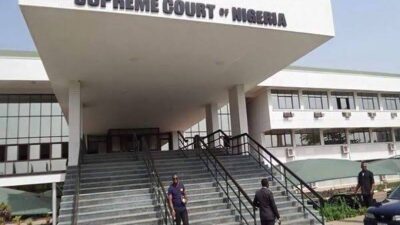
Shortly after the judgment, the ADC, which was represented by its National Welfare Secretary, Mr. Nkem Ukandu, said the party would take the case before the Supreme Court.
END

















Comments