

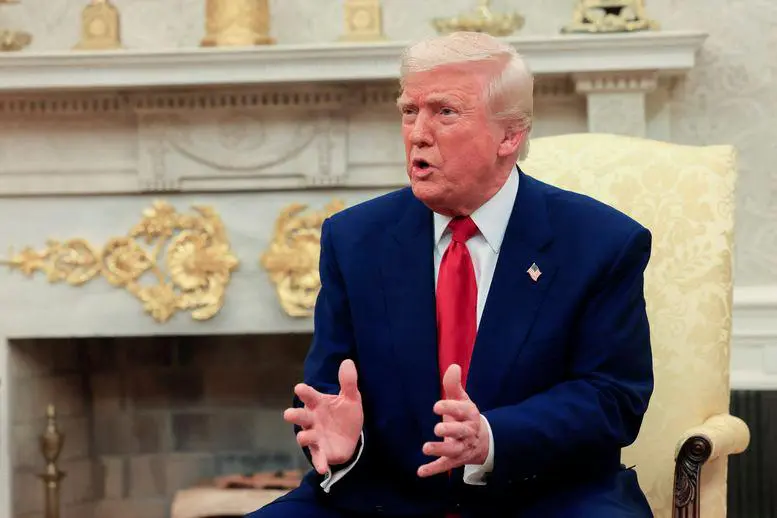
US President Donald Trump has promised to pay a $5,000 federal “dividend” to every adult American if Republicans retain control of both chambers of Congress in the November midterm elections.
Trump made the pledge on Wednesday at the Republican Party’s first-ever midterm convention in Dallas, Texas, as he urged voters to support Republican candidates and maintain the party’s control of the House of Representatives and Senate.
“If the Republicans win the House of Representatives and the United States Senate, both of them,” Trump said, he would issue a payment of $5,000 to every adult citizen in the United States.
Trump described the proposed payment as a dividend but did not provide details on how it would be funded or administered.
He said the payment would come with a condition that the money must be spent within the United States.
The proposal could represent a massive federal expenditure. Reuters estimated that providing $5,000 to approximately 270 million American adults could cost about $1.35 trillion.
The legality and practical implementation of the proposal remain unclear, while Vice President JD Vance appeared to suggest that higher-income Americans could potentially be excluded.
The pledge comes as Republicans campaign to retain their congressional majorities in the November 3 midterm elections, in which all 435 House seats and about one-third of Senate seats are up for election.
Although Trump is not on the ballot, he has placed himself at the centre of the Republican campaign, urging supporters to vote as though he were personally running.
The proposed payment also echoes an earlier idea for direct payments to Americans. In 2025, Trump considered a “DOGE dividend” funded by savings generated by the Department of Government Efficiency, following a proposal by Elon Musk for $5,000 taxpayer refund cheques. That plan, however, did not result in a nationwide payment.
Trump’s latest announcement remains a political promise rather than an existing federal payment programme. Any implementation would require congressional and administrative action, as well as a clear funding mechanism.














Comments