

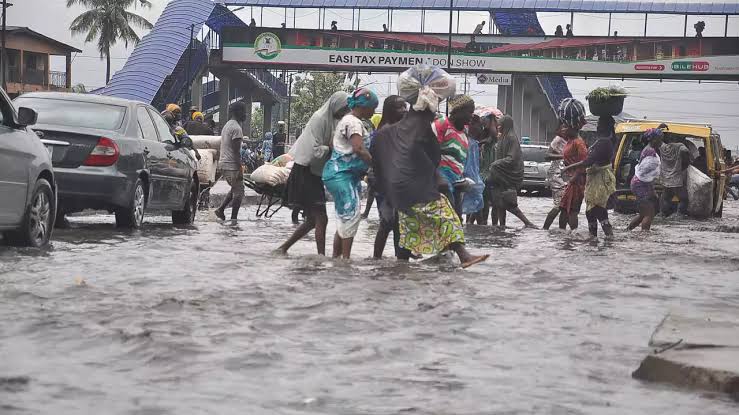
The Lagos State Government has defended its ongoing flood control initiatives, insisting that recent heavy rainfall across the state resulted only in temporary flash floods and not widespread flooding, despite the growing impact of climate change.
Commissioner for the Environment and Water Resources, Tokunbo Wahab, made the remarks on Friday after inspecting drainage channels and flood-prone areas, including Oniru, Chevron Drive, Agungi-Ajiran, Freedom Road, and Orange Island.
Reacting to public criticism following the recent downpours, Wahab said attempts to portray the flooding as government failure were politically motivated and overlooked the progress made over the past three years.
“Some people have chosen to politicise the issue instead of acknowledging the work being done. This administration has worked tirelessly to improve waste management, ban styrofoam and certain plastics, remove illegal structures on floodplains, protect wetlands, and expand drainage infrastructure,” he said.
According to the commissioner, the state’s interventions have prevented more severe flooding, noting that Lagos is currently experiencing short-lived flash floods rather than prolonged flooding.
“What we have in Lagos is not overflowing flooding. It is flash flooding in some locations, and within a few hours, the water recedes,” Wahab explained.
Drawing a comparison with recent flooding in Ghana, he said the measures currently being implemented by the Lagos State Government are similar to those the Ghanaian government is only beginning to introduce following severe flooding in Accra.
Wahab also disclosed that the government had already recorded noticeable improvements around Chevron Drive and Ajiran after clearing illegal encroachments blocking major drainage channels.
He recalled that officials had faced resistance from suspected land grabbers, who allegedly attempted to obstruct drainage restoration with the backing of armed security personnel. However, the government successfully reopened the blocked channels, leading to improved water discharge into the lagoon within days.
The commissioner reiterated that the inspection exercise was aimed at assessing flood-prone areas, engaging residents, and identifying locations requiring permanent engineering solutions.
He also warned against illegal land reclamation, particularly around major discharge points into the lagoon, stressing that such activities worsen flooding and threaten public safety.
“If we allow illegal reclamation to continue without environmental approvals or drainage clearance, we would be acting irresponsibly,” he said.
On concerns over inadequate drainage infrastructure within communities, Wahab said the state government was partnering with local government councils while executing major drainage projects beyond the financial capacity of local authorities.
He explained that the state would construct key drainage collectors and roads before transferring responsibility for maintenance to local governments.
Addressing indiscriminate waste disposal, the commissioner vowed that the government would continue prosecuting offenders while intensifying public awareness campaigns and improving waste collection services.
He announced that the Lagos State Government plans to deploy between 140 and 150 additional waste compactors to strengthen the operations of the Lagos Waste Management Authority (LAWMA).
Wahab added that the completion of new material recovery facilities and transfer stations before the end of the year would remove over 4,000 tonnes of waste from landfill daily, significantly easing pressure on the state’s waste management system and supporting long-term flood prevention efforts.















Comments