

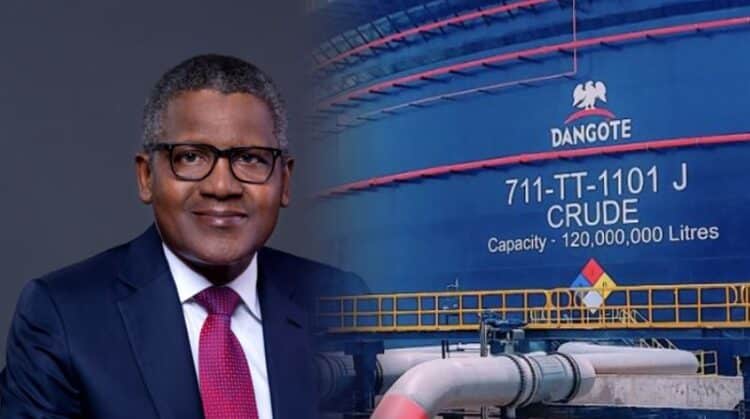
Uncertainty has gripped Nigeria’s downstream petroleum sector as marketers suspend large-scale fuel purchases following the Dangote Petroleum Refinery’s decision to price Premium Motor Spirit (PMS), also known as petrol, in US dollars.
The development has triggered concerns over a possible rise in fuel prices, with some filling stations temporarily shutting down due to dwindling supplies. However, the Dangote Refinery has dismissed reports that it halted fuel loading, insisting that operations remain uninterrupted.
Marketers say they are delaying fresh purchases while awaiting clarity on the refinery’s new pricing template and the cost of incoming imported petroleum products.
The National Publicity Secretary of the Independent Petroleum Marketers Association of Nigeria (IPMAN), Chinedu Ukadike, said the uncertainty has forced marketers to adopt a cautious approach.
According to him, most of the fuel currently being sold was purchased earlier at between ₦1,250 and ₦1,300 per litre, while uncertainty over the pricing of new crude supplies and imported products has made it risky to buy fresh stock.
“The challenge is that no one knows what the next pricing template will be. If marketers buy now and prices drop shortly after, they will be forced to sell at a loss while consumers still expect lower pump prices,” Ukadike explained.
He noted that although fuel distribution has not completely stopped, the volume of products being loaded has reduced significantly.
Ukadike called on the Federal Government to urgently resolve the pricing dispute to prevent further disruption in the downstream sector.
Similarly, the IPMAN Western Zone Chairman, Oyewole Akanni, confirmed that many marketers across the South-West have suspended fresh purchases, leading to temporary closures of some filling stations.
He alleged that the situation began after the Dangote Refinery reportedly suspended PMS loading about four days earlier, forcing marketers to source products from private depots at higher prices.
According to Akanni, ex-depot prices in Lagos now range between ₦1,200 and ₦1,220 per litre, excluding transportation costs, while some private depots are selling as high as ₦1,250 per litre.
He disclosed that four truckloads of petrol meant for his filling stations have remained at the refinery since loading was allegedly suspended.
Despite the situation, Akanni urged Nigerians not to panic-buy fuel, insisting there is no nationwide fuel scarcity at the moment, although pump prices could rise if the uncertainty persists.
Dangote Denies Halting Fuel Loading
A spokesperson for the Dangote Group dismissed claims that the refinery had stopped loading petroleum products, describing the reports as “fake news.”
“The refinery is loading. Anybody can visit the facility and confirm. It is false to say we are not loading,” the official said.
The spokesperson also claimed that rising petrol prices in Lomé, Togo, have made it increasingly difficult for fuel importers to compete with Dangote’s pricing.
FG, Dangote Locked in Pricing Dispute
Meanwhile, fresh details have emerged on the ongoing disagreement between the Federal Government and the Dangote Petroleum Refinery over crude oil supply and fuel pricing.
A senior government official familiar with the negotiations disclosed that the refinery’s decision to adopt a dollar-based pricing model stems from dissatisfaction over two key issues.
According to the official, Dangote is unhappy with the continued issuance of petrol import licences despite its refining capacity and believes the Nigerian National Petroleum Company Limited (NNPCL) is not supplying sufficient crude oil to the refinery.
The source also claimed that only a limited portion of the crude supplied is sold in naira, forcing the refinery to purchase the majority in US dollars.
“The refinery believes it is not receiving enough crude and that the amount being sold in naira is too small. As a result, it says it has no choice but to adopt a dollar pricing model if the situation remains unchanged,” the official said.
The government, however, insists it cannot grant a monopoly by restricting fuel imports while ensuring the country maintains adequate foreign exchange earnings from crude oil sales.
Officials also noted that because the Dangote Refinery operates within a Free Trade Zone, it enjoys certain legal and tax incentives, including flexibility over the currency used for commercial transactions.
FCCPC Insists Naira Remains Legal Tender
The Federal Competition and Consumer Protection Commission (FCCPC) has maintained that the naira remains Nigeria’s only lawful currency for domestic commercial transactions.
Reacting to reports that the refinery may sell petrol in US dollars, the Commission’s Director of Corporate Affairs, Ondaje Ijagwu, said all domestic transactions should be conducted in naira.
Ijagwu also expressed concern that recent declines in global crude oil prices have not translated into corresponding reductions in retail petrol prices.
He said the Federal Government has already convened meetings involving regulators, refiners and marketers to address the pricing concerns.
Legal Battle Over Fuel Imports
Adding another layer to the dispute, three major oil marketers—Matrix Energy Group, AA Rano Nigeria and AYM Shafa Holdings—have approached the Federal High Court in Abuja seeking an order compelling regulators to continue issuing licences for petroleum product imports.
The marketers argue they have invested billions of dollars in storage, logistics and distribution infrastructure and should not be prevented from importing fuel.
The legal challenge is expected to complicate the Federal Government’s efforts to balance support for domestic refining while maintaining competition in the petroleum market.
For now, uncertainty over pricing, crude supply and import policies continues to cast a shadow over Nigeria’s fuel market, raising concerns that prolonged negotiations could eventually push petrol prices even higher.
















Comments