

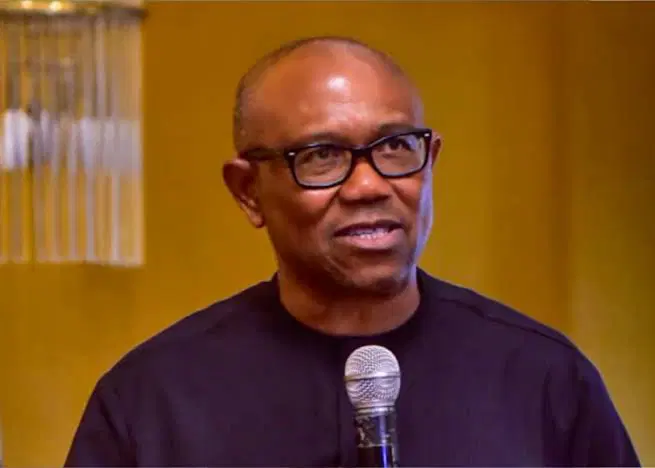
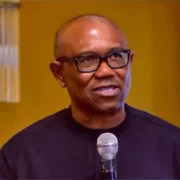
The chances of Nigeria Democratic Congress (NDC) presidential candidate Peter Obi making significant gains in Northern Nigeria ahead of the 2027 presidential election have sparked fresh debate among political analysts and supporters of the Obi-Kwankwaso movement.
The debate followed comments by Amb. Abdul Danbature, National President of the Arewa Youth Assembly for Good Leadership, who claimed that Obi could not become president without the support of Northern youths.
Danbature had also accused the former Anambra State governor of failing to consult Northern youths before declaring his presidential ambition.
He further argued that Northern voters would support candidates who backed former President Muhammadu Buhari.
However, political analyst Abba Gwale disagreed with the assessment, maintaining that Obi remains capable of attracting substantial support in the North.
Gwale said although Northern votes remain crucial to winning a presidential election in Nigeria, Obi could build on the support he secured in the region during the 2023 election.
“It is crystal clear that Northern votes are crucial in Nigerian presidential elections. In fact, it is extremely difficult for any presidential candidate to win the presidency without significant support from the North,” Gwale said.
He noted that the strategic importance of the region explains why major presidential contenders are investing heavily in winning over Northern voters ahead of 2027.
According to him, Obi already demonstrated an ability to attract support in parts of the North during the 2023 election, particularly among young and Christian voters.
“Looking back at the 2023 presidential election, he secured the majority of Northern Christian votes, particularly among young people,” he said.
Gwale, however, cautioned that the political landscape in 2027 may differ significantly from that of 2023, noting that changing political circumstances could influence voter preferences.
He said Obi could nevertheless retain a significant portion of his previous support, particularly if his campaign effectively responds to demographic and political realities in the region.
The analyst also identified the choice of Obi’s running mate as a major factor that could influence his prospects in the North.
He said a potential alliance with former Kano State governor Rabiu Kwankwaso could strengthen Obi’s position, particularly in Kano and parts of Jigawa, Kaduna and Katsina.
“With Rabiu Kwankwaso as his vice-presidential candidate, his political influence, especially in Kano and parts of Jigawa, Kaduna and Katsina, could boost the ticket’s prospects,” Gwale said.
He, however, warned that Kwankwaso’s supporters may not automatically transfer their loyalty to Obi.
“Kwankwaso commands a loyal support base, although the extent to which those supporters would automatically transfer their votes to Obi is uncertain and would depend on campaign dynamics and voter preferences,” he added.
Gwale also pointed to the political activities of the ruling All Progressives Congress (APC), particularly its reported efforts to attract opposition governors, many of whom are from Northern states.
He described the development as another indication of the strategic importance of Northern Nigeria to the 2027 presidential contest.
Despite the challenges, Gwale maintained that Obi should not be written off in the region.
“Ultimately, Peter Obi could remain competitive in parts of the North if his campaign team builds on the strategies that resonated with voters in 2023 while adapting to the realities of the next election,” he said.
Obi-Kwankwaso Movement Rejects Arewa Youth Claim
Reacting to Danbature’s comments, Coordinator of the FCT Obi-Kwankwaso (OK) Movement, Mallam Jabir, dismissed the claim that Northern youths would reject Obi because he did not consult them before declaring his presidential ambition.
Jabir described the statement as “senseless and irrational,” arguing that such claims often emerge during election periods from groups seeking political relevance.
He accused some self-styled youth organisations of using religion and ethnicity as political tools to influence voters and deepen divisions.
“Politics of religion, politics of ethnicity and all these things are nothing but political tools used by politicians to divide Nigerians so that they can remain in power or in position,” Jabir said.
He urged Nigerians to be cautious about claims by individuals or groups seeking to speak for entire ethnic, regional or religious populations ahead of the 2027 election.
‘Nobody Can Speak for Northern Youth’ — Kwankwasiyya
Similarly, spokesperson of the Kwankwasiyya Movement, Habeeb Mohammed Saleh, said no individual or organisation has the mandate to determine how Northern youths will vote in 2027.
Saleh questioned the legitimacy of Danbature’s claim, arguing that there is no recognised structure with the authority to speak collectively for all Northern youths.
“We don’t know of any structure that represents unanimously, the Northern youth. Neither do we have somebody legitimately placed in any place or in any capacity to speak about what the Northern youths are actually going to do,” he said.
He described the claim as an attempt to attract attention and possibly serve personal or political interests.
According to Saleh, Northern youths have become more politically conscious and are increasingly concerned about issues such as insecurity, hunger, unemployment and economic hardship.
“I believe the Northern youths have passed such a time when they fold their arms, close their eyes and just follow a certain footstep that may end up leading them to more darkness, more insecurity, more hunger and more problems in the North,” he said.
Saleh also challenged the assertion that Obi lacks significant support in the region, pointing to his performance in the 2023 presidential election.
He said Obi secured more than two million votes in Northern Nigeria despite not having the backing of Kwankwaso or the Kwankwasiyya Movement at the time.
“For him to say so, where was he when Peter Obi garnered more than two million votes in the North at that particular time, even when he wasn’t enjoying the backing of Senator Rabiu Musa Kwankwaso and even the Kwankwasiyya Movement?” Saleh asked.
‘Northern Voters Will Decide Based on Reality’
On the suggestion that Northern voters would only support candidates who backed former President Muhammadu Buhari, Saleh questioned the basis of such a position.
He argued that voters would be more likely to assess candidates based on the realities affecting their lives rather than loyalty to former political leaders.
Saleh criticised the record of the Buhari administration and questioned whether invoking the former president’s name would still have the same political influence ahead of 2027.
He also argued that many Nigerians who supported President Bola Tinubu in 2023 did so with expectations of improved living conditions but have since become disappointed with the government’s performance.
According to him, issues such as insecurity, hunger and economic hardship would play a major role in determining voting patterns in 2027.
“I don’t think anybody can speak for the Northern voters this time around. I believe the reality before us will lead the way,” Saleh said.
He maintained that attempts to dictate how millions of Northern voters would vote could ultimately fail, insisting that voters would make their decisions based on the issues confronting them.
“The reality of the insecurity we have, the reality of the hunger, the reality of deceptions bundled and packaged as a renewed hope,” he added.
Saleh further argued that attempts to use Buhari’s political legacy to influence Northern voters could backfire, particularly among those who remain dissatisfied with the former administration.
As the 2027 election draws closer, the competing narratives highlight the growing importance of Northern Nigeria, where the ability of political parties and candidates to win over diverse voting blocs could prove decisive in the presidential contest.


Comments