

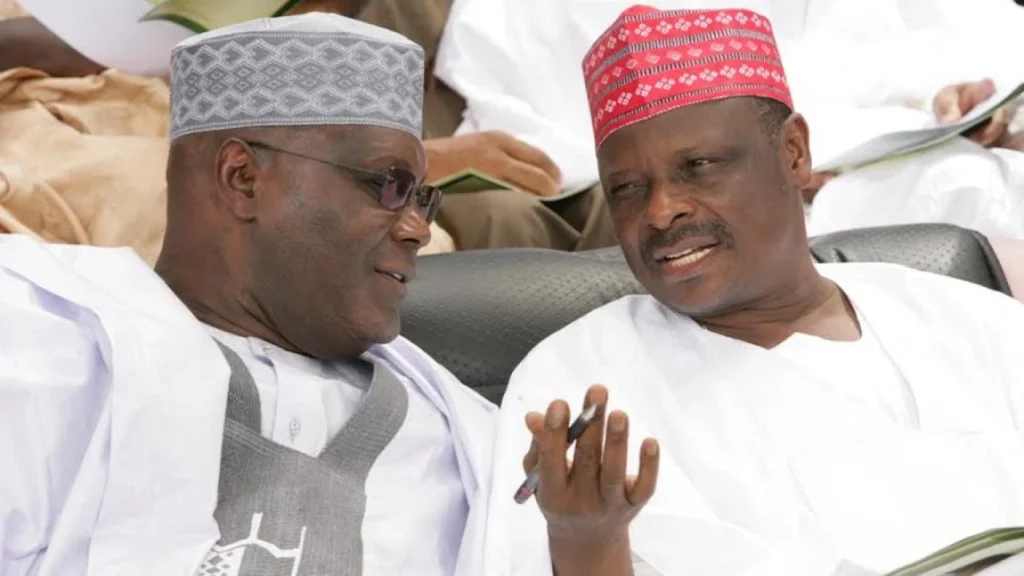
As political realignments ahead of the 2027 presidential election continue to gather momentum, mixed reactions have emerged across Northern Nigeria over the possible electoral implications of former Vice President, Atiku Abubakar, and former Kano State Governor, Rabiu Musa Kwankwaso, contesting on separate political platforms.
The growing debate follows reports of a potential alliance involving Peter Obi and Kwankwaso, while Atiku is expected to pursue his presidential ambition independently with a yet-to-be-announced running mate.
Speaking on the emerging political permutations, an ADC chieftain, Adnan Mukhtar Tudun Wada, said the North could witness a divided voting pattern due to competing political interests and alliances.
According to him, Kwankwaso’s political influence remains strongest in Kano State, while Atiku enjoys wider acceptance across several northern states.
“Kwankwaso’s political dominance is largely concentrated in Kano. Atiku, on the other hand, has built support structures across the North over the years,” he stated.
Wada also noted that some northern voters remain skeptical about Obi’s participation in any joint ticket, citing lingering sentiments from the 2023 presidential election.
“The religious and regional sentiments that surfaced during the last election are still factors many northern voters are considering, and this may affect the strength of any Obi-Kwankwaso alliance,” he added.
He further argued that dissatisfaction with the ruling All Progressives Congress among northern voters could push many towards supporting a northern presidential candidate in 2027.
According to him, perceptions that Kwankwaso may settle for a vice-presidential role have also discouraged some of his loyal supporters.
Meanwhile, Kano Obidient Coordinator, Barrister Ibrahim Muhammad, expressed a contrary view, insisting that the proposed alliance between Obi and Kwankwaso could significantly reshape the political landscape in the North.
He explained that the voting pattern in 2027 would depend largely on regional influence, running mate selections, and which candidate voters believe has the strongest chance of defeating President Bola Ahmed Tinubu.
“The northern vote may split differently from what happened in 2023 because of the changing alliances and coalition talks currently ongoing,” he said.
Muhammad pointed to discussions involving opposition parties and political figures, including members of the LP, SDP, APGA, and defectors from the APC, as signs of a broader coalition movement ahead of the election.
He maintained that an Obi-Kwankwaso alliance could perform strongly across Kano, Jigawa, Kaduna, Katsina, Zamfara, Sokoto, and other North-West states, while Obi’s popularity may further boost support in parts of the North-East and North-Central regions.
According to him, many northern voters now view Atiku’s political ambition as personal rather than part of a united opposition movement.
However, activist Mamman Buhari dismissed the chances of both Atiku and Kwankwaso, accusing the political actors of pursuing personal interests over national concerns.
“Both camps appear driven more by political ambition than genuine unity. Nigerians are also beginning to question Atiku’s repeated presidential bids,” he said.
With opposition negotiations intensifying and new alliances taking shape, analysts believe the battle for northern votes could become one of the defining factors of the 2027 presidential election.










Comments