

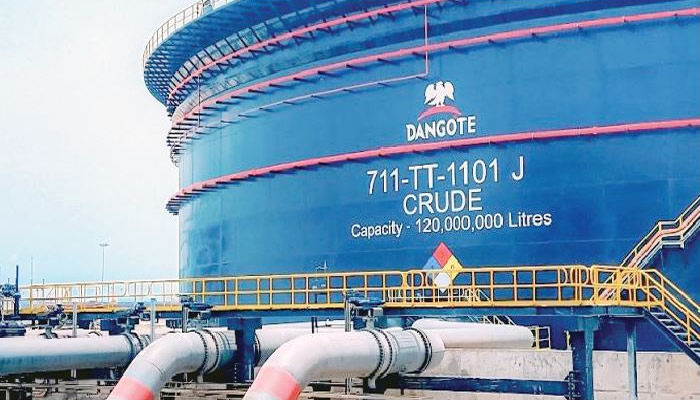
The Dangote Petroleum Refinery has dragged the Federal Government to court over the issuance of fresh petrol import licences to oil marketing companies, intensifying the growing battle over Nigeria’s downstream petroleum market.
The lawsuit, filed before the Federal High Court in Lagos, challenges the decision of the Nigerian Midstream and Downstream Petroleum Regulatory Authority (NMDPRA) to approve new import permits for six major marketers despite the country’s rising local refining capacity.
Industry documents showed that the licences authorised the importation of between 600,000 and 720,000 metric tonnes of Premium Motor Spirit (PMS), popularly known as petrol.
The affected companies include NIPCO, AA Rano, Matrix Energy, Shafa Energy, Pinnacle Oil and Gas, and Bono Energy, with allocations ranging from 60,000 to 150,000 metric tonnes each.
The development signals a major policy reversal after the regulator reportedly suspended fresh petrol import approvals in February and March 2026, citing improved domestic refining output.
According to data released by the NMDPRA, the Dangote refinery supplied about 36.5 million litres of petrol daily in February 2026, accounting for over 90 per cent of Nigeria’s estimated daily consumption. Petrol imports during the period reportedly dropped to about three million litres per day — the lowest level recorded in a year.
In its court filing, the refinery argued that continued issuance and renewal of import licences violate provisions of the Petroleum Industry Act (PIA), which permits fuel importation only when local production cannot meet domestic demand.
The company maintained that allowing large-scale imports despite improved local capacity undermines domestic refining operations and discourages investment in Nigeria’s petroleum processing sector.
The fresh approvals have, however, sparked sharp debate across the industry. While some stakeholders defend the move as necessary to guarantee competition and supply security, others warn that unrestricted imports could weaken local refining investments and return Nigeria to heavy dependence on foreign fuel supplies.
Speaking during an interview with the Chief Executive Officer of Norway’s Sovereign Wealth Fund, Nicolai Tangen, President of the Dangote Group, Aliko Dangote, alleged that influential fuel importers were still working against the refinery’s success.
Dangote claimed that entrenched interests in the oil sector feared the refinery would disrupt long-standing import arrangements that enabled massive fuel importation despite Nigeria being a major crude oil producer.
He said the refinery project, launched in 2013, faced numerous obstacles, including delays linked to land acquisition and opposition from vested interests benefiting from the old fuel subsidy regime.
According to him, Nigeria previously spent nearly $10 billion annually on fuel subsidies, creating enormous profits for importers, traders and shipping operators involved in the importation of refined petroleum products.
Dangote said some import allocation beneficiaries viewed the refinery as a direct threat to their businesses.
“These are the people that are not agreeing for us to settle down because they believe that we are coming to displace them. Of course, that’s what we have done now,” he stated.
He further maintained that the refinery was built to end decades of fuel scarcity and strengthen Nigeria’s — and Africa’s — energy security by reducing dependence on imported refined products.















Comments