

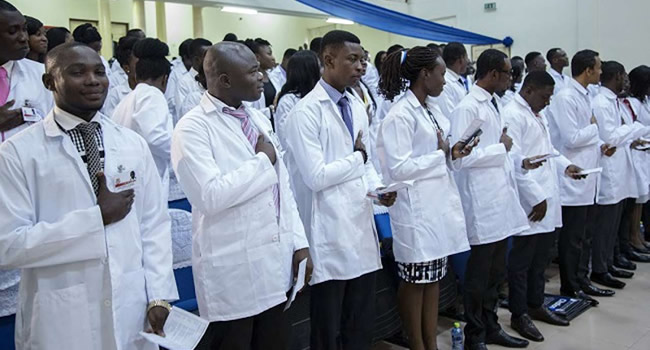
LAGOS — Medical professionals have sounded the alarm over a worsening healthcare manpower crisis in Nigeria, revealing that only about 55,000 doctors are currently available to serve a population of more than 220 million people.
The warning was issued during the Ordinary General Meeting and Scientific Conference of the Association of Resident Doctors (ARD), Federal Neuropsychiatric Hospital (FNPH), Yaba, Lagos, where experts highlighted the devastating impact of the growing shortage of healthcare workers, particularly in the mental health sector.
Speaking at the event, President of the Nigerian Medical Association (NMA), Prof. Bala Audu, represented by Prof. Omoti Ernest, disclosed that although the Medical and Dental Council of Nigeria (MDCN) has registered over 130,000 doctors, only about 55,000 remain actively practicing in the country.
According to him, the figure translates to roughly one doctor for every 3,600 to 4,000 Nigerians, far below the World Health Organisation’s recommended ratio of one doctor to 600 people.
“The shortage has placed tremendous pressure on the healthcare system, resulting in increased workload, burnout among medical personnel, longer waiting times for patients, and declining quality of care,” Ernest said.
Healthcare experts attributed the crisis largely to the continued migration of Nigerian doctors and other health professionals abroad in search of better opportunities. Estimates presented at the conference indicated that over 16,000 doctors have left Nigeria within the last five years, while approximately 94,000 doctors and nurses have emigrated since the onset of the “Japa” trend.
Consultant Psychiatrist at the Neuropsychiatric Hospital, Aro, Dr. Yesir Kareem, described the situation as particularly troubling for mental healthcare services.
He noted that more than 40 million Nigerians are currently living with mental health disorders, yet nearly 85 percent lack access to adequate psychiatric care.
“Only about 55,000 doctors remain to serve over 220 million Nigerians, while the country’s doctor-to-patient ratio in some areas exceeds one doctor to 10,000 patients,” Kareem said.
He warned that the shortage of psychiatrists and mental health specialists has widened treatment gaps, delayed diagnoses, increased healthcare costs, and contributed to preventable deaths across the country.
The President of the Association of Psychiatrists in Nigeria (APN), Dr. Veronica Nyamali, revealed that Nigeria currently has fewer than 150 psychiatrists serving the entire population.
According to her, the exodus of healthcare workers has forced consultants to take on responsibilities meant for multiple specialists, leaving little room for research and advanced patient care.
“There are shortages at every level. Work meant for four psychiatrists is now being handled by one or two people. Consultants are increasingly filling roles they should ordinarily supervise,” she said.
Nyamali also warned that the scarcity of specialists has made mental healthcare more expensive and less accessible, especially in rural communities where psychiatric services are virtually unavailable.
She further linked the manpower shortage to the growing burden of mental illness driven by poverty, insecurity, unemployment, substance abuse, kidnapping, and other traumatic experiences affecting millions of Nigerians.
Medical experts identified poor remuneration, delayed salaries, inadequate healthcare infrastructure, limited career advancement opportunities, insecurity, and poor working conditions as major factors fueling the migration of doctors.
To reverse the trend, the NMA called on the Federal Government to improve salaries and welfare packages, invest in modern healthcare facilities, expand residency and specialist training programmes, and provide incentives for professionals willing to work in underserved communities.
The doctors also advocated greater investment in mental healthcare, wider deployment of telepsychiatry services, and the integration of mental health treatment into primary healthcare centres nationwide.
In a communiqué issued after the conference, the Association of Resident Doctors reaffirmed its commitment to improving healthcare delivery and urged authorities to take urgent steps to address the manpower crisis before it further undermines Nigeria’s healthcare system.
The association warned that unless decisive action is taken, the continued loss of healthcare professionals could worsen access to medical services and deepen the country’s growing public health challenges.













Comments