

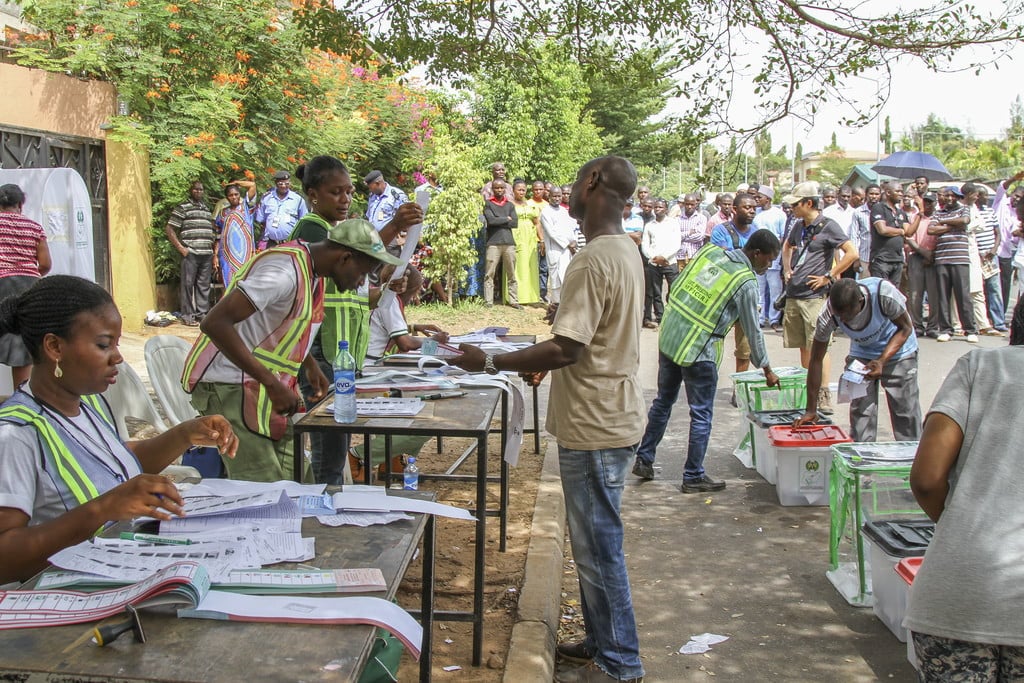
Political parties participating in the June 20, 2026 governorship election in Ekiti State on Thursday signed a peace accord, pledging to uphold peace and ensure a violence-free electoral process before, during, and after the election.
Among the signatories was Governor Biodun Oyebanji, candidate of the All Progressives Congress, who reaffirmed the commitment of political actors and residents of the state to sustaining Ekiti’s tradition of peaceful elections.
Speaking at the event, Chairman of the Independent National Electoral Commission, Joash Amupitan, urged political parties and their supporters to demonstrate the true spirit of the agreement beyond merely appending signatures to the document.
According to him, Ekiti has earned a reputation for political maturity and peaceful conduct, stressing that all stakeholders must work collectively to preserve the state’s democratic image throughout the election period.
Amupitan commended the National Peace Committee for its consistent efforts in promoting democratic stability and reducing electoral tensions across the country.
He noted that following the successful implementation of the peace accord framework during the November 2025 governorship election in Anambra State, the commission was determined to replicate the model in Ekiti.
The INEC chairman explained that the peace accord initiative, first introduced during the Edo governorship election in September 2020, had gradually become institutionalised in off-cycle governorship elections across several states.
Providing updates on preparations for the election, Amupitan disclosed that 1,059,360 registered voters are expected to participate in the poll across the state’s 16 local government areas, 177 registration areas, and 2,445 polling units.
He further revealed that the commission had mobilised 52,446 members of the National Youth Service Corps for the forthcoming off-cycle governorship elections and bye-elections in states including Ekiti, Osun State, Nasarawa State, Enugu State, Rivers State, Ondo State, Kebbi State, and Kano State.
Amupitan added that the electoral body had strengthened its logistics, technology deployment, and result management systems to ensure a credible election, while warning against vote-buying, voter intimidation, and political violence.
He also disclosed that 54 media organisations and 470 journalists had applied for accreditation to cover the election, alongside 96 domestic observer groups and two international observer missions.
The INEC chairman stressed that leadership attained through violence and incitement would amount to a hollow victory, urging political leaders to educate their supporters on peaceful participation throughout the electoral process.
Chairman of the National Peace Committee and former Head of State, Abdulsalami Abubakar, represented by Martin Agwai, described the peace accord as a collective pledge toward credible, free, fair, and peaceful elections.
He called on political parties and their supporters to reject violence, hate speech, and all forms of electoral misconduct, warning that no political ambition should be allowed to endanger lives or threaten public peace.
Inspector-General of Police, Olatunji Disu, said the accord underscored the need for elections to remain a contest of ideas rather than a trigger for conflict.
He assured residents that security agencies, working through the Inter-Agency Consultative Committee on Election Security, had put adequate measures in place to secure all polling units and guarantee a peaceful, free, and credible election.
Disu further pledged that security personnel would maintain professionalism, neutrality, and commitment to safeguarding democratic values throughout the election process.

















Comments