

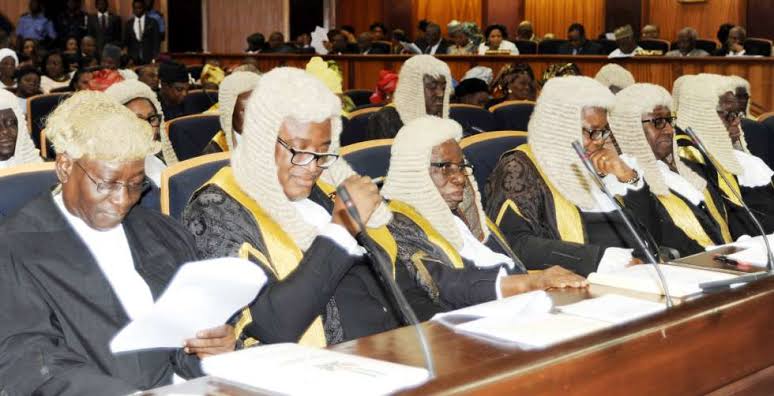
The Independent Judicial Accountability Panel (IJAP), convened under the CiTi-Act project of ActionAid Nigeria (AAN), has called for the unbundling of the office of the Chief Justice of Nigeria (CJN) as part of measures to strengthen accountability, transparency and efficiency in the country’s judiciary.
The panel made the recommendation at the end of its fifth session in Abuja on Thursday, where it reviewed a range of issues concerning judicial accountability and the delivery of election justice ahead of the 2027 general elections.
Chairman of the panel, retired Justice Mojeed Adekunle Owoade, said concentrating too many responsibilities in the office of the CJN could weaken institutional checks and balances.
According to him, there should be clearly defined deputies for the heads of all courts, with specific responsibilities assigned to them adding that, the arrangement would help distribute powers and provide internal checks against possible abuse or excessive concentration of authority.
“We may sometimes have a Chief Justice who is level-headed and things are going well, but years ahead, we may have a head of court who will just follow his own agenda,” Owoade said.
He added that clearly defined roles for deputies would provide a system of checks and balances within the judiciary.
The panel also revisited its recommendation for a two-level election litigation system under which disputes arising from National Assembly and governorship elections would ordinarily terminate at the Court of Appeal.
However, IJAP proposed that the Supreme Court should retain limited jurisdiction to entertain such cases in exceptional circumstances, subject to leave of the Court while citing the Plateau State election litigation as an example of circumstances that informed the recommendation.
He noted that while the governor in the case obtained a remedy at the Supreme Court, other lawmakers whose cases arose from similar circumstances could not proceed beyond the Court of Appeal and consequently lost their cases.
The panel said the proposed exception was intended to address unusual situations where parties facing substantially similar facts receive different outcomes because of the existing limits on appellate jurisdiction.
IJAP further recommended a constitutional amendment to restrict former political appointees and Directorate-level staff of the Independent National Electoral Commission (INEC) from engaging in partisan politics for at least five years after leaving the Commission.
It also called for constitutional recognition of independent candidacy to broaden participation in elections and reduce the influence of political godfatherism, while urging that safeguards be introduced to prevent an excessive proliferation of candidates.
The panel recommended allowing citizens to institute public interest litigation over breaches of the Electoral Act and constitutional provisions relating to the conduct of elections and also maintained that INEC should not be a statutory respondent in election petitions.
On constitutional voting procedures, IJAP urged the National Assembly to comply with provisions requiring specific voting thresholds by using an ascertainable record of votes rather than voice votes.
The fifth session also reviewed the recent Supreme Court decision in Peoples Democratic Party (PDP) v. Alhaji Sule Lamido & 4 Ors. in suit No. SC/CV/164/2026 and observed that the majority decision reaffirmed the principle established in Onuoha v. Okafor that courts generally should not interfere in the internal affairs of political parties, except where there is a breach of a party’s constitution.
The panel, however, expressed concern that sections 83(5) and 83(6) of the Electoral Act 2026 could create uncertainty over the extent to which courts may determine disputes arising from the internal affairs of political parties.
It also recommended that, INEC should serve as the first level of resolution for internal party disputes, in line with its constitutional regulatory responsibilities even as it urged Commission to become more proactive and effective in regulating political parties.
IJAP disclosed that it had engaged the Office of the Attorney-General of the Federation and the Nigerian Law Reform Commission on its reform proposals, adding that, the Federal Ministry of Justice had expressed willingness to collaborate on recommendations that align with its current priorities, while its engagement with the Law Reform Commission provided an avenue to identify areas requiring legislative reform and strengthen civil society participation in law reform.
END

















Comments