

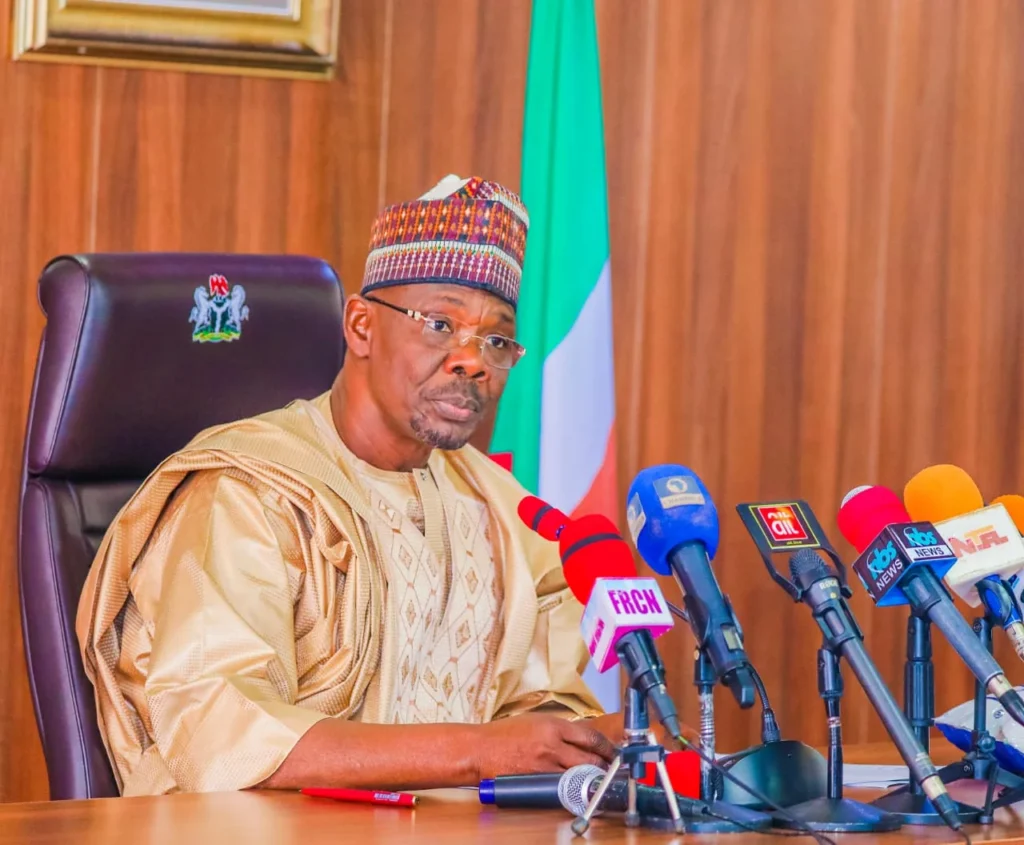
Governor Abdullahi Sule and former Information Minister Labaran Maku have expressed contrasting views on the conduct of the Nasarawa North Senatorial by-election, with the governor praising the voting process as seamless while Maku alleged widespread technical failures and electoral irregularities.
Governor Sule, who voted at Polling Unit 002, Gudi Motor Park, alongside his wives, Hajiya Silifat Abdullahi Sule and Hajiya Farida Abdullahi Sule, described the exercise as one of the smoothest elections he has witnessed in recent years.
Speaking with journalists shortly after casting his ballot, the governor commended the efficiency of the accreditation and voting process.
“For me, this is the smoothest it has ever been. From BVAS accreditation to casting my ballot, it took just three to five minutes. Historically, this is the fastest I’ve seen,” Sule said.
The governor also dismissed suggestions that the by-election was a test of his political strength ahead of the 2027 general elections, insisting that the poll was instead an opportunity for the people of Nasarawa North to assess the performance of the ruling All Progressives Congress.
“It is an opportunity for the people of Nasarawa North to say thank you to APC. By the grace of God, we are going to see a ‘thank you’ result,” he added.
However, Maku painted a different picture, alleging that several polling units across the senatorial district experienced significant challenges with the Bimodal Voter Accreditation System (BVAS).
While acknowledging that his own accreditation was completed without difficulty at his Wakama Ward polling unit, the former minister claimed that numerous voters were unable to be accredited due to malfunctioning devices.
“Quite a number of people, the BVAS could not capture their fingerprints and they have been waiting there since morning,” Maku alleged.
He urged the Independent National Electoral Commission to adopt facial recognition technology as an alternative means of accreditation whenever fingerprint verification fails, noting that voters’ photographs are already contained in the electoral register.
Maku further claimed that similar technical issues were reported at polling centres in Wamba Central and Wamba Clinic, where officials allegedly struggled to repair faulty accreditation machines.
The former minister also alleged that some BVAS devices exhausted their internet data allocation shortly after accreditation commenced.
“At my polling unit, we had to volunteer data to INEC officials to enable them continue the accreditation process,” he said.
Beyond the technical concerns, Maku raised allegations of multiple thumbprinting of ballot papers in some communities, including Alushi and Wacho. However, electoral authorities had yet to officially confirm the claims as of the time of filing this report.
Despite the concerns, Maku acknowledged that voting remained largely peaceful across many polling units but warned that tensions often escalate during the collation of results.
“It is when results are being collated that people introduce violence when they see they are not winning,” he cautioned.
He called on security agencies to ensure adequate protection during the transportation and collation of election materials and results.
Maku also criticized what he described as a growing culture of “win-at-all-costs” politics, arguing that governments should rely on their performance and developmental achievements rather than political manipulation to secure electoral victories.
The by-election was conducted to fill the vacant Nasarawa North Senatorial seat following the death of Godiya Akwashiki.
As of press time, INEC had not issued an official response to the allegations of BVAS malfunction, internet connectivity challenges, or other reported irregularities, while collation of results remained ongoing.










Comments