

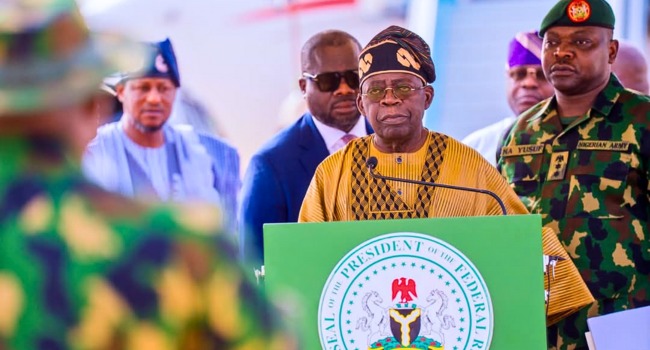
The presidential candidate of the Social Democratic Party (SDP), Prince Adewole Adebayo, has warned Nigerians against re-electing President Bola Tinubu in 2027, describing such a decision as equivalent to “drinking poison.”
Adebayo said another four years under the Tinubu administration could have devastating consequences for Nigerians, insisting that citizens could not afford to endure what he described as broken promises and poor leadership.
He made the remarks during an interactive question-and-answer session with Nigerians on X, formerly Twitter, where he outlined his vision for addressing the country’s economic, security and infrastructural challenges.
The SDP candidate argued that Nigeria’s greatest problem was not the scale of its challenges but the inability of successive governments to take responsibility and demonstrate the leadership capacity required to solve them.
According to him, Nigeria is at a critical crossroads, but its current difficulties are neither unique nor beyond the reach of competent leadership.
Adebayo maintained that the country has the human and material resources needed to overcome its challenges, stressing that effective governance, proper planning and responsible leadership are essential to achieving meaningful progress.
He urged Nigerians, particularly young people, to take an active interest in the country’s future and avoid electoral apathy, ignorance and intolerance.
Explaining his comparison between voting for the All Progressives Congress (APC) and drinking poison, Adebayo said poor electoral decisions have consequences that extend beyond individual voters.
He noted that insecurity, kidnapping, terrorism, displacement and other national challenges affect the entire population, including those who did not support the government responsible for addressing them.
“Elections do not affect only the person who votes; they affect the entire society,” he argued, adding that democracy requires collective responsibility and informed decision-making.
Adebayo also criticised what he described as a recurring pattern in Nigerian politics, where leaders make ambitious campaign promises but begin asking citizens for more time after assuming office.
Using the biblical account of the Wall of Jericho as an illustration, he said political leaders often appear unprepared for the challenges they encounter after winning elections.
He recalled previous economic policies, including the austerity measures introduced under the Shehu Shagari administration in 1982 and the Structural Adjustment Programme (SAP) implemented during Ibrahim Babangida’s regime, arguing that successive governments had repeatedly asked Nigerians to endure economic hardship in anticipation of better days.
Turning to the Tinubu administration, Adebayo said Nigerians were promised that the removal of fuel subsidy would free up resources for improved electricity supply, job creation, better living conditions and economic prosperity.
However, he argued that the expected transformation had yet to materialise, despite the administration approaching the end of its first four-year term.
He insisted that leaders must be judged by their ability to deliver tangible results rather than repeatedly asking citizens for more time.
On his proposed solutions, Adebayo called for stronger institutions, an effective justice system, professional policing and a united, patriotic military capable of defending the country.
He also emphasised the need for quality education, functional healthcare, reliable infrastructure and proper management of Nigeria’s resources.
Citing the country’s transportation challenges, he questioned why Nigeria continued to struggle with basic road and bridge infrastructure despite its relatively straightforward geographical layout.
The SDP candidate further lamented what he described as a departure from the aspirations of Nigeria’s founding fathers, who envisioned the country as a leading force in Africa and a symbol of the advancement of the black race.
He urged Nigerians to educate themselves about available political alternatives, examine candidates’ records and make informed choices ahead of the 2027 general election.
Adebayo maintained that Nigeria’s future depended largely on the decisions citizens make today, warning that electoral apathy and uninformed voting could prolong the country’s economic and security difficulties.






Comments