

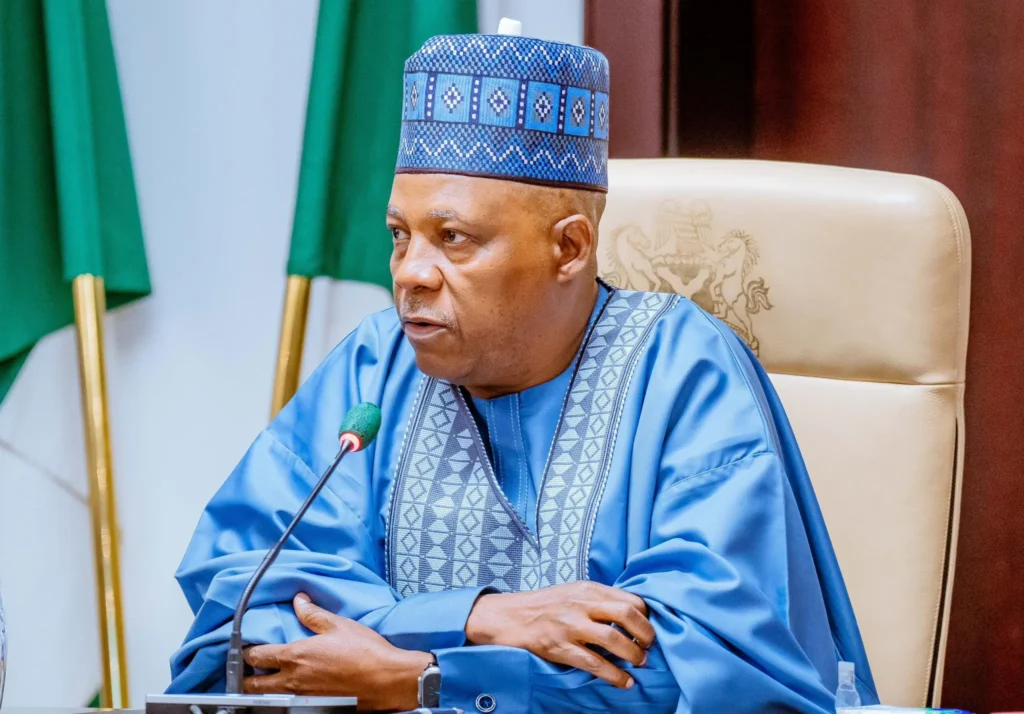
Nigeria has reiterated its commitment to promoting and protecting human rights while ensuring strict adherence to international humanitarian standards in conflict situations.
Vice President Kashim Shettima made this known on Thursday in Abuja while declaring open the 2026 High-Level International Humanitarian Law Dialogue. He emphasized that the administration of Bola Ahmed Tinubu is prioritizing a comprehensive strategy to address insecurity through both military (kinetic) and non-military (non-kinetic) measures.
According to the Vice President, insecurity remains Nigeria’s greatest threat to peace and development, necessitating a balanced approach that integrates force with dialogue, reforms, and community-based interventions. He noted that the government is also strengthening legal frameworks to respond to evolving security challenges.
As part of these efforts, Shettima highlighted the recent domestication of the African Union Kampala Convention, aimed at providing a robust legal structure for the protection and assistance of internally displaced persons across the country.
He described the dialogue as timely, coming at a period when global and local conflicts continue to test the limits of humanitarian principles. Nigeria, he said, remains deeply affected by insurgency, terrorism, and other forms of violence, with long-term impacts on communities and institutions.
Reaffirming Nigeria’s position, Shettima stressed that international humanitarian law must go beyond policy documents and be reflected in real-life actions. He outlined three core pillars guiding Nigeria’s approach: protection of civilians, humane treatment of affected persons, and preservation of human dignity in all circumstances.
The Vice President further disclosed that Nigeria has taken proactive steps to implement these principles, including integrating humanitarian law into military training, strengthening child protection systems, improving accountability for sexual violence, enhancing arms control, and expanding displacement management frameworks.
He also commended global partners such as the United Nations, International Committee of the Red Cross, and the International Criminal Court for their continued support in strengthening Nigeria’s humanitarian law systems.
In his remarks, the Attorney General of the Federation and Minister of Justice, Lateef Fagbemi, reaffirmed the government’s commitment to reforming the justice sector through new laws and investments in correctional facilities to ensure humane treatment and rehabilitation of inmates.
He added that humanitarian law principles are being embedded into the operations and training of military and law enforcement agencies, with ongoing efforts to translate these laws into local languages for wider accessibility, particularly in conflict-affected areas.
Earlier, the Solicitor General of the Federation, Beatrice Jeddy-Agba, described the dialogue as a critical platform for reinforcing the rule of law within Nigeria’s security framework. She reaffirmed Nigeria’s alignment with the Geneva Conventions and stressed the need for stronger political will to ensure compliance both globally and locally.
The event brought together key stakeholders from international organizations, government institutions, and the judiciary, all focused on strengthening Nigeria’s adherence to international humanitarian law in the face of evolving conflict dynamics.













Comments