

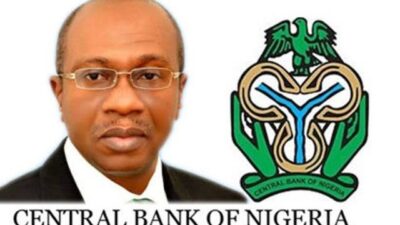
Abuja — The Federal Government’s reliance on domestic borrowing surged sharply in 2025 despite record-high interest rates, significantly widening the credit gap between the public and private sectors, according to data from the Central Bank of Nigeria (CBN).
An analysis of CBN money and credit statistics shows that credit to the Federal Government increased by ₦9.19 trillion in 2025, while credit to the private sector contracted by ₦1.54 trillion, underscoring mounting fiscal pressure and a growing crowding-out effect within the financial system.
The data reveal that government borrowing outpaced private sector credit by ₦9.19tn, representing a 695.6 per cent swing during the year, as banks increasingly channelled funds into government securities rather than lending to businesses and households.
Government Absorbs Liquidity as Businesses Struggle
CBN figures show that credit to the Federal Government rose from ₦25.03tn in January 2025 to ₦34.22tn by December, driven largely by increased issuance of Treasury bills and bonds to finance budget deficits and refinance existing obligations.
In contrast, private sector credit fell from ₦77.38tn in January to ₦75.83tn in December, reflecting tight liquidity conditions, weak demand, and borrowing costs approaching 30 per cent.
Analysts say the divergence highlights an imbalance in credit allocation, with the public sector absorbing a disproportionate share of available funds at the expense of productive economic activities.
Classic Crowding-Out Effect
In monetary terms, credit to government represents funds extended through government securities and direct lending by financial institutions, while private sector credit supports business expansion, manufacturing, agriculture, trade, and consumer activity.
Economists warn that when government borrowing rises sharply in a high-interest-rate environment, it limits banks’ ability and willingness to lend to businesses — a phenomenon known as crowding out.
Experts Raise Alarm
Commenting on the trend, Segun Kadir Ajayi, Director-General of the Manufacturers Association of Nigeria (MAN), said the data clearly show that government borrowing is squeezing out private sector access to credit.
“When banks find it easier and safer to lend to government at high interest rates, the productive sector suffers,” Ajayi said. “Manufacturers are scaling back borrowing for expansion and raw material sourcing because the cost of credit is simply too high.”
Ajayi added that weak consumer demand and limited liquidity have further dampened borrowing appetite among businesses.
Banks Prefer Government Debt — Economist
Also reacting, Muda Yusuf, Chief Executive Officer of the Centre for the Promotion of Private Enterprise (CPPE), said banks are increasingly favouring government securities because they offer high returns with minimal risk.
“The government finances deficits through bonds and treasury bills, which banks prefer because the risk is low and the yields are attractive,” Yusuf said. “Private sector lending is riskier, and with interest rates this high, businesses cannot compete.”
Yusuf warned that declining private sector credit is a red flag for economic growth, investment, and job creation, noting that Nigeria’s credit-to-GDP ratio remains weak compared to peer economies.
Calls for Policy Rebalancing
Both experts urged the government to reduce domestic borrowing, improve revenue mobilisation, and work towards lowering interest rates to restore balance in credit allocation.
With inflation still elevated and monetary policy tight, stakeholders say failure to rebalance credit flows could prolong economic stagnation and weaken industrial growth.
As fiscal pressures persist following subsidy reforms and exchange-rate adjustments, the widening gap between government and private sector borrowing is expected to remain a key indicator of strain within Nigeria’s financial system.















Comments