

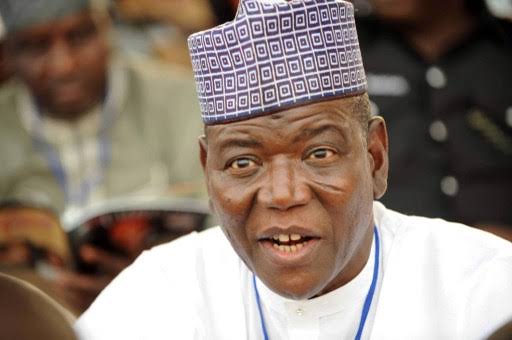
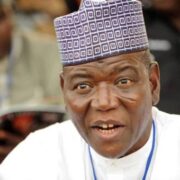
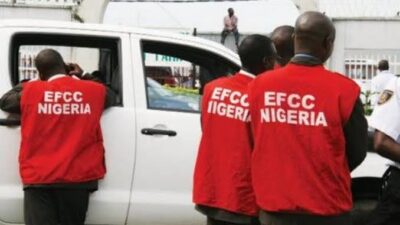
The fresh arraignment of former Governor of Jigawa State, Alhaji Sule Lamido at the Federal High Court sitting in Abuja over alleged N1.3 billion corruption charges brought against him by the Economic and Financial Crimes Commission (EFCC) has again been aborted.
Lamido alongside his two sons, Aminu Lamido and Mustapha Lamido, who allegedly committed the fraud with their father through fictitious contract awards were to be docked on Wednesday, April 1 but could not hold despite the presence of all the defendants in court.
The arraignment had, on March 13 suffered same fate due to the absence of all the defendants in court occasioned by late service of trial notice on them.
However, at Wednesday’s proceedings after Lamido and his sons have been put in the dock for their plea to be taken, the EFCC objected to fresh arraignment of the accused persons.
Chile Okoroma, SAN who appeared for EFCC objected to fresh arraignment on the ground that such would amount to violation and confrontation to the Supreme Court order.
He drew the attention of trial Judge, Justice Peter Lifu to the judgment of the Supreme Court delivered on January 16, 2026 to the effect that Justice Ijeoma Ojukwu who started the trial in 2015 and having gone halfway before her transfer to Calabar division of the Court should try the case to conclusion.
Okoroma said, the EFCC had written to the Chief Judge of the Federal High Court, Justice John Tsoho for a fiat to bring Justice Ijeoma Ojukwu back from Calabar to Abuja to resume the trial as ordered by Supreme Court.
He then pleaded with Justice Lifu to adjourn the matter to await the reaction of the Chief Judge adding that he would not want the time of the court to be wasted on the fresh arraignment.
The EFCC counsel recalled that his client had called 17 witnesses who testified against the defendants before closing its case for them to open their defense.
Following a no objection from Chief Joe Agi, SAN who represented the defendants, Justice Lifu fixed April 30 to await the reaction of the Chief Judge to the request by the anti-graft agency.
EFCC had in 2015 charged Lamido, his two sons and their companies before the Federal High Court in Abuja on a 27-count charge bordering on money laundering to a tune of N1.3 billion allegedly siphoned from Jigawa state in a money laundering scheme.
Lamido and his co-defendants allegedly committed the offences during his time as the governor of the state.
The EFCC said Lamido abused his office between 2007 and 2015 by laundering funds received as kickbacks from state government contracts.
Apart from the Lamidos, other defendants are their companies, Bamaina Holdings Ltd and Speeds International Ltd.
After EFCC had called more than 17 witnesses and closed its case, the defendants filed a no‑case submission, arguing that the prosecution had not presented sufficient evidence to require them to open their defence.
But, the trial judge, Justice Ijeoma Ojukwu dismissed the submission and ordered them to enter defence in November 2022.
Lamido, went on appeal against the ruling and in July 2023, the Court of Appeal upheld the no‑case submission and ruled that the Federal High Court in Abuja lacked territorial jurisdiction to sit on the case in the first place.
The Court of Appeal held that the trial should have been conducted in Jigawa State, where the alleged offences occurred.
However, in August 2023, EFCC proceeeded to the Supreme Court asking it to overturn the Court of Appeal decision.
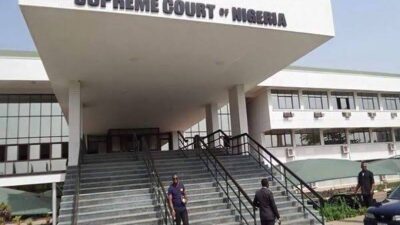
The Supreme Court on January 16, 2026 set aside the decision of the Court of Appeal that discharged Sule Lamido and his sons, Mustapha and Aminu, of money laundering charges.
A five‑member panel of the apex court handed down the decision in a unanimous judgment delivered by Justice Abubakar Umar, holding that the defendants had a case to answer and ordered that the matter be returned to the Federal High Court for continuation of trial.
END




Comments