

President Bola Ahmed Tinubu has declared that 2026 will usher Nigeria into a more robust phase of economic growth, as key reforms begin to deliver measurable gains across critical sectors of the economy.
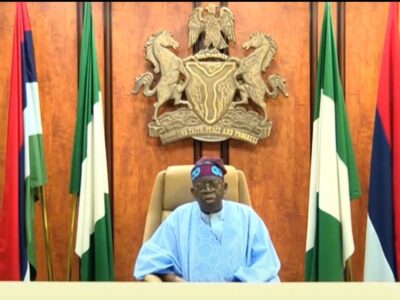
The President made this known on Thursday in his New Year message to Nigerians, where he reviewed the country’s economic and security outlook and outlined his administration’s priorities for the year ahead.
Tinubu said Nigeria ended 2025 on a strong footing despite global economic headwinds, citing steady GDP growth, improved exchange rate stability, declining inflation, and renewed investor confidence.
According to him, Nigeria recorded robust GDP growth in every quarter of 2025, with annualised growth projected to exceed 4 per cent. He added that inflation declined steadily and fell below 15 per cent, aligning with the government’s target, while trade surpluses were sustained throughout the year.
The President also highlighted the performance of the Nigerian Stock Exchange, which posted a 48.12 per cent gain in 2025, consolidating a bullish run that began in the second half of 2023. He noted that Nigeria’s foreign reserves stood at $45.4 billion as of December 29, 2025, providing a strong buffer against external shocks and supporting the stability of the naira.
On foreign investment, Tinubu said foreign direct investment rose sharply to $720 million in the third quarter of 2025, up from $90 million in the previous quarter, attributing the increase to growing investor confidence and positive assessments from global credit rating agencies, including Moody’s, Fitch, and Standard & Poor’s.
Looking ahead, the President said the focus in 2026 would be on consolidating economic gains, reducing inflation further, and ensuring that the benefits of reform reach ordinary Nigerians. He stressed that moderating inflation and interest rates would create more fiscal space for investment in infrastructure and human capital development.
Tinubu also reaffirmed his administration’s commitment to tax reforms, particularly the harmonisation of taxes across all tiers of government to reduce the burden of multiple taxation on citizens and businesses. He said the reforms are aimed at building a fair, competitive, and sustainable fiscal system capable of funding infrastructure and social investments.
On security, the President acknowledged ongoing threats from terrorists and criminal groups but said decisive actions had been taken, including operations carried out in collaboration with international partners. He assured Nigerians that security and intelligence agencies would deepen cooperation with regional and global partners in 2026 to eliminate threats to national security.
Tinubu reiterated his support for decentralised policing, complemented by regulated forest guards, as a critical step in addressing terrorism, banditry, and related crimes.
The President announced that 2026 would mark an acceleration of the Renewed Hope Ward Development Programme, with plans to empower at least 1,000 people in each of Nigeria’s 8,809 wards, targeting the inclusion of at least 10 million Nigerians in productive economic activities through agriculture, trade, food processing, and mining.
He also pledged continued investment in infrastructure, including roads, power, ports, railways, airports, healthcare, education, and agriculture, assuring that all ongoing projects would continue without interruption.
Tinubu called on Nigerians to remain united and committed to nation-building, stressing that economic progress must be matched by patriotism, integrity, and collective responsibility.
“Nation-building is a shared responsibility,” the President said, as he wished Nigerians a peaceful, productive, and prosperous New Year.











Comments